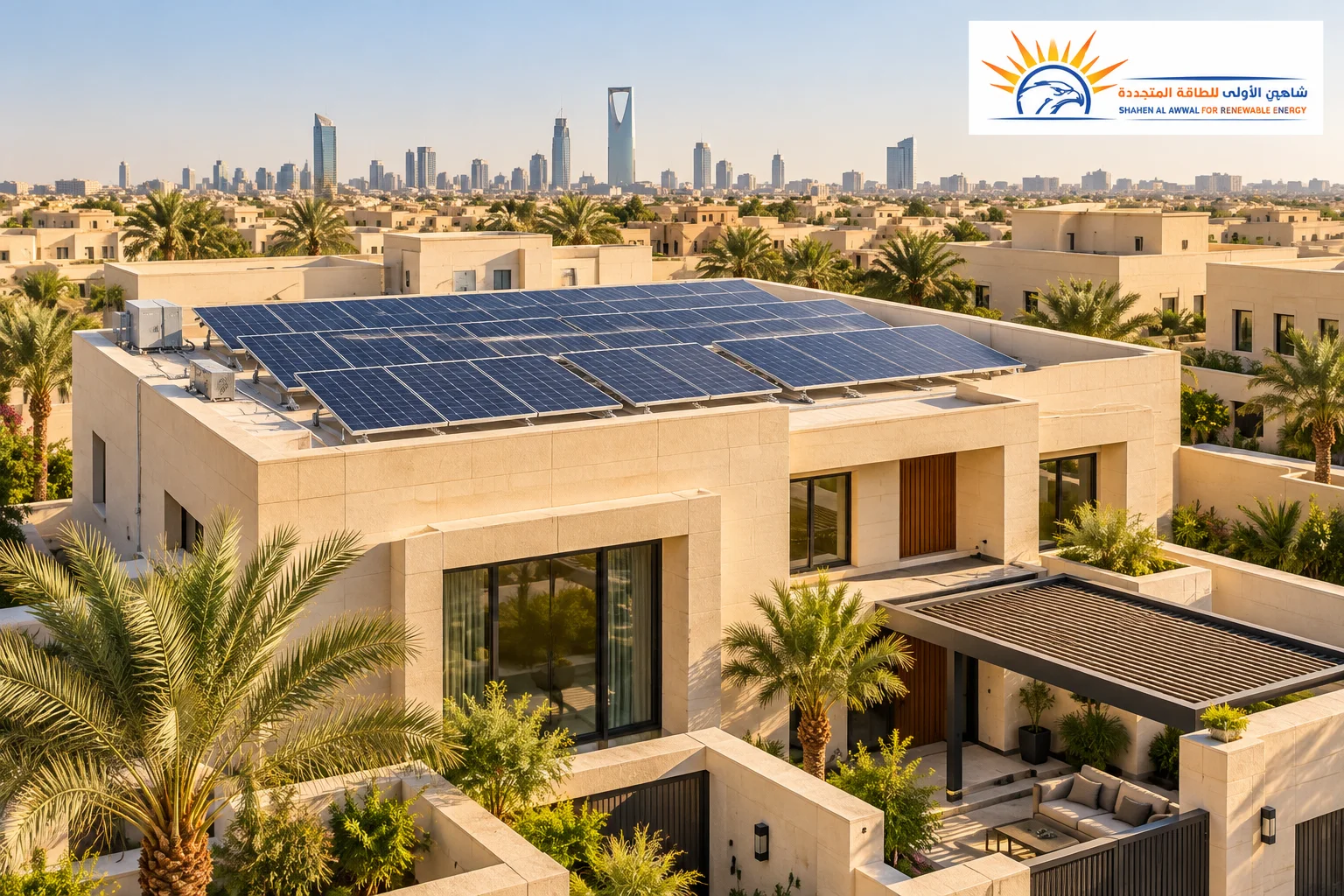
Choosing a home solar system starts with understanding your electricity consumption and the goal of the project. Shahen provides system studies, design, component supply, installation, and maintenance based on each site’s needs. One homeowner may want to use less grid power during the day, while another needs to run essential appliances during outages, or to power a home far from the grid. Each goal calls for a different design in terms of panel capacity, inverter type, and the need for batteries. In this guide you’ll learn the steps for choosing, calculating, and evaluating a system, with worked examples to help you compare offers in the Saudi market.
What Is a Home Solar System?
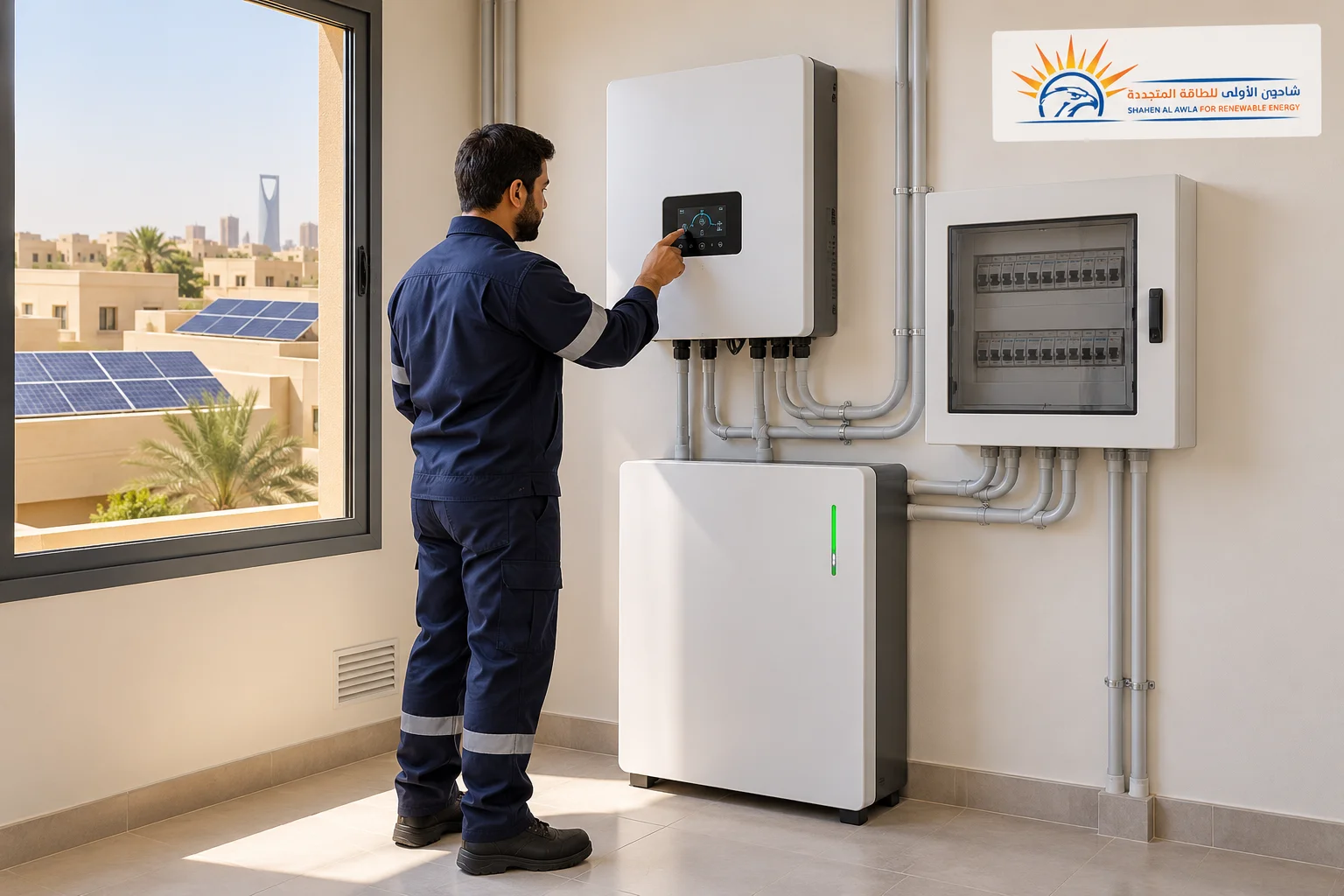
A home solar system is made up of equipment that works together to turn sunlight into electricity you can use at home. The panels produce direct current, the inverter converts it into alternating current suitable for your appliances, and protection and control devices manage operation and protect the components.
The system can work alongside the grid, rely on energy storage, or combine more than one source. So there is no single setup that suits every home, even when homes are similar in size.
For more on the components and what they do, read our guide to solar system components.
Define Your Goal Before Choosing the Capacity
Before buying a home solar system, be clear about the result you want: are you aiming to cut part of your bill, run backup loads, or become independent of the grid?
Defining the goal helps you avoid buying batteries you don’t need, or expecting a system designed for a few appliances to run the whole house. You should also decide whether the project will serve only your current home or allow for future additions such as more air conditioners, an outdoor room, or a water pump.
The Main Types of Home Systems
A home solar system can be built in three common designs, and the choice depends on site conditions and when you use power:
| Type | How it works | Batteries |
|---|---|---|
| On-grid | Uses solar power alongside the grid | Usually not needed |
| Off-grid | Powers loads without relying on the public grid | Needs suitable storage for night-time loads |
| Hybrid | Combines several sources according to the design | Used depending on the goal and the equipment’s capabilities |
A conventional grid-tied system usually shuts down during a grid outage and does not provide automatic backup.
For more on the first option, read our article on on-grid solar systems for homes and villas.
How to Calculate Your Home’s Consumption
Designing a home solar system requires reviewing several months of bills, especially since air conditioning use changes between summer and winter. Then identify your main loads, how long they run, and when.
Use this formula for a preliminary estimate:
Daily energy (kWh) = appliance power (W) × operating hours ÷ 1,000.
Refrigerators and air conditioners have variable consumption, so measured data or the energy label is more accurate than assuming they run at full power all day.
A Practical Load Calculation Example
To estimate what your home solar system needs to supply, you can prepare a table like this hypothetical example:
| Appliance | Usage assumption | Daily consumption |
|---|---|---|
| 10 LED bulbs | 10 W × 5 hours | 0.5 kWh |
| Television | 100 W × 4 hours | 0.4 kWh |
| Two fans | 60 W per fan × 6 hours | 0.72 kWh |
| Laptop | 60 W × 5 hours | 0.3 kWh |
| Refrigerator | Assumed consumption over the day | 1.2 kWh |
The total is 3.12 kWh before losses. This example doesn’t include air conditioning or water heating, and you should replace the figures with your own appliances’ consumption.
How to Choose the Panel Capacity
The panel capacity of a home solar system depends on the target energy, solar radiation, expected losses, and installation space. Choosing a random number of panels and then looking for appliances to match isn’t enough.
As an illustration, if the target is 12 kWh per day, assuming five peak sun hours and an 80% performance ratio, the preliminary capacity is:
12 ÷ (5 × 0.8) = 3 kW.
This is a simplified estimate that needs a simulation for the site and season.
For more on comparing technologies, read our guide to the best types of solar panels in Saudi Arabia.
Is Your Roof Space Suitable?
Before committing to a home solar system, measure the usable roof area after excluding obstacles, shading, and the walkways needed for maintenance.
The installation area varies with panel dimensions, tilt, and row layout. You should also check the condition of the roof, the mounting method, and waterproofing, and avoid mounting that blocks water drainage or access to tanks and equipment.
Don’t use your home’s built-up area to estimate solar space; similar roofs can differ a lot in how panels can be arranged.
For more on dimensions and space, read our article on solar panel sizes.
Choosing the Right Inverter
The inverter affects the performance of a home solar system and its compatibility with the panels, appliances, and batteries. Check its continuous power, voltage and current limits, number of MPPT inputs, and monitoring features.
If you want to run backup loads, ask about the backup output capacity, the transfer method, and which appliances it can supply. Confirm the starting requirements of compressors and pumps, and note that a kVA rating doesn’t always equal real power in kW.
For more on the differences, read our guide to types of solar inverters.
When Do You Need Batteries?
Adding batteries to a home solar system is useful when you need to store production or run specific loads outside sunshine hours, depending on the type of system.
If your home is grid-connected and the goal is to use solar output during the day, storage may not be necessary. So ask what value a battery will add compared with its cost and future replacement needs.
Check the usable capacity, discharge rate, warranty, temperature range, and compatibility with the inverter.
For more on choosing one, read our article on types of solar batteries.
Calculating the Storage Capacity You Need
The battery for a home solar system is sized from the loads you need to run over a given period, not from the number of panels alone.
If you need to supply an average load of 500 watts for six hours, the energy required is 3 kWh. Assuming an 80% usable depth of discharge and 90% conversion efficiency, the approximate nominal capacity becomes:
3 ÷ (0.8 × 0.9) = 4.17 kWh.
A suitable margin is added according to the design, and you should confirm the battery can deliver the current your loads need.
For more on storage characteristics, read our guide to lithium batteries.
Do You Need a Separate Charge Controller?
The inverter in a home solar system may have a built-in charge controller, while other designs use a separate controller.
The choice is settled by reviewing the system diagram and equipment specifications, not by buying each component separately. Confirm the panel input limits, the battery charging current, the settings for its type, and whether it can communicate with the battery management system.
Compatible components reduce operating problems, while adding an unsuitable device can complicate the system without any benefit.
For more on what it does and the types available, read our article on solar charge controllers.
Can It Run Air Conditioners?
A home solar system can be designed to help power air conditioners, but this requires studying actual consumption, the number of units, operating hours, and how many loads run at the same time.
An AC unit drawing an assumed 1.2 kW for five hours needs about 6 kWh. Real consumption changes with outdoor temperature, insulation, thermostat setting, and the unit’s efficiency.
The cooling capacity printed on the unit is not its electricity consumption. Running it during the day is also very different from running it at night on batteries, in terms of cost and storage size.
How Much Does the System Produce Per Day?
The output of a home solar system varies with the city, season, panel orientation and tilt, shading, and losses. So there is no fixed daily figure that can be guaranteed from the capacity alone.
Ask for a monthly and annual estimate with the assumptions explained, and use a simulation based on your location. Tools such as PVGIS let you enter capacity, tilt, orientation, and losses to estimate production.
A home that isn’t connected to the grid needs a more conservative study to cover loads and storage during periods of lower production.
For more on this design, read our guide to off-grid solar power systems.
Heat, Dust, and Conditions in Saudi Arabia
The components of a home solar system should be chosen for the site’s conditions and according to the manufacturer’s instructions, with proper ventilation for the inverter and battery.
Cell temperature affects panel performance, and production can drop because of dust or shading. At coastal sites, the corrosion resistance of mounting structures and fasteners deserves special attention.
Set a cleaning schedule based on site conditions, and don’t assume plenty of sunshine makes up for poor mounting or dirty panels. Safe maintenance access should also be provided without walking on panels or putting cables under strain.
How Much Does a Home System Cost?
The cost of a home solar system varies with capacity, type of operation, components, storage capacity, and site work.
Ask for a quotation that specifies:
- The models and quantities of panels and inverters.
- Batteries and their usable capacity, if any.
- Mounting structures, cables, and protection.
- Design, installation, and testing.
- Warranty, transport, taxes, and exclusions.
Don’t compare a system without batteries with a complete backup system on total price alone; a different scope of work can explain the difference in cost.
For more on budget items, read our article on the cost of home solar installation in Saudi Arabia.
How to Compare Company Offers
When buying a home solar system, compare offers on the same basis, covering capacity, models, scope of installation, warranty, and expected production.
Ask for an explanation of any savings figure, and make sure it is linked to your consumption and when you use electricity. Don’t assume all the energy produced will automatically turn into financial savings of the same value.
The right company sets out its responsibilities for the survey, installation, and follow-up, and provides documents that help you evaluate the offer instead of relying on a general marketing description.
For more on how to compare providers, read our guide to the best solar installation company in Saudi Arabia.
Installation and Handover Steps
Installing a home solar system starts with analyzing consumption and surveying the site, followed by preparing the design and approving the equipment and scope of work.
After installation, the connections, protection, earthing, and equipment settings are inspected, and operation is tested according to the design. At handover, ask for the system diagram, datasheets, warranties, monitoring data, and an explanation of alerts.
You should agree on the connection requirements for the project and who is responsible for them, and clarify whether the system supports backup or needs additional equipment.
For more on the stages of work, read our article on solar installation in Saudi Arabia.
Monitoring and Maintenance After Commissioning
A home solar system needs regular monitoring of production and alerts, and periodic inspection of components according to the manufacturer’s instructions.
Compare performance under similar conditions and record any unusual drop. The cause may be dirt, new shading, settings, or a fault that needs a specialist.
Keep a record of maintenance and warranties, and agree on how faults are reported, response times, and spare parts availability. Avoid opening connections or carrying out electrical repairs yourself; correct diagnosis comes before replacing equipment.
Can the system be expanded later?
It may be possible, but the inverter capacity, panel limits, battery compatibility, and available space must be checked before adding anything.
Start by gathering your electricity bills, photos of the roof, and a list of appliances, then request a study and quotation from Shahen that sets out the capacity, components, cost, and scope of work that suit your home.
Frequently Asked Questions
Can solar power run the whole house?
A home solar system can be designed to cover a wide range of loads, but that depends on consumption, space, budget, and the available power sources.
Do solar panels work at night?
Panels don’t produce power from sunlight at night; power then comes from batteries, the grid, or another source, depending on the design.