An off-grid solar power system is one of the best solutions for locations that public electricity doesn’t reach, or that need an independent, reliable source of power. Shahen First Renewable Energy Company delivers complete solutions for designing and building off-grid solar systems tailored to the nature of each site and its real requirements. Whether you own a farm, a rest house, a campsite, a monitoring station, or a project in a remote area, relying on solar energy gives you greater independence and a clear reduction in long-term operating costs.
What Is an Off-Grid Solar Power System?
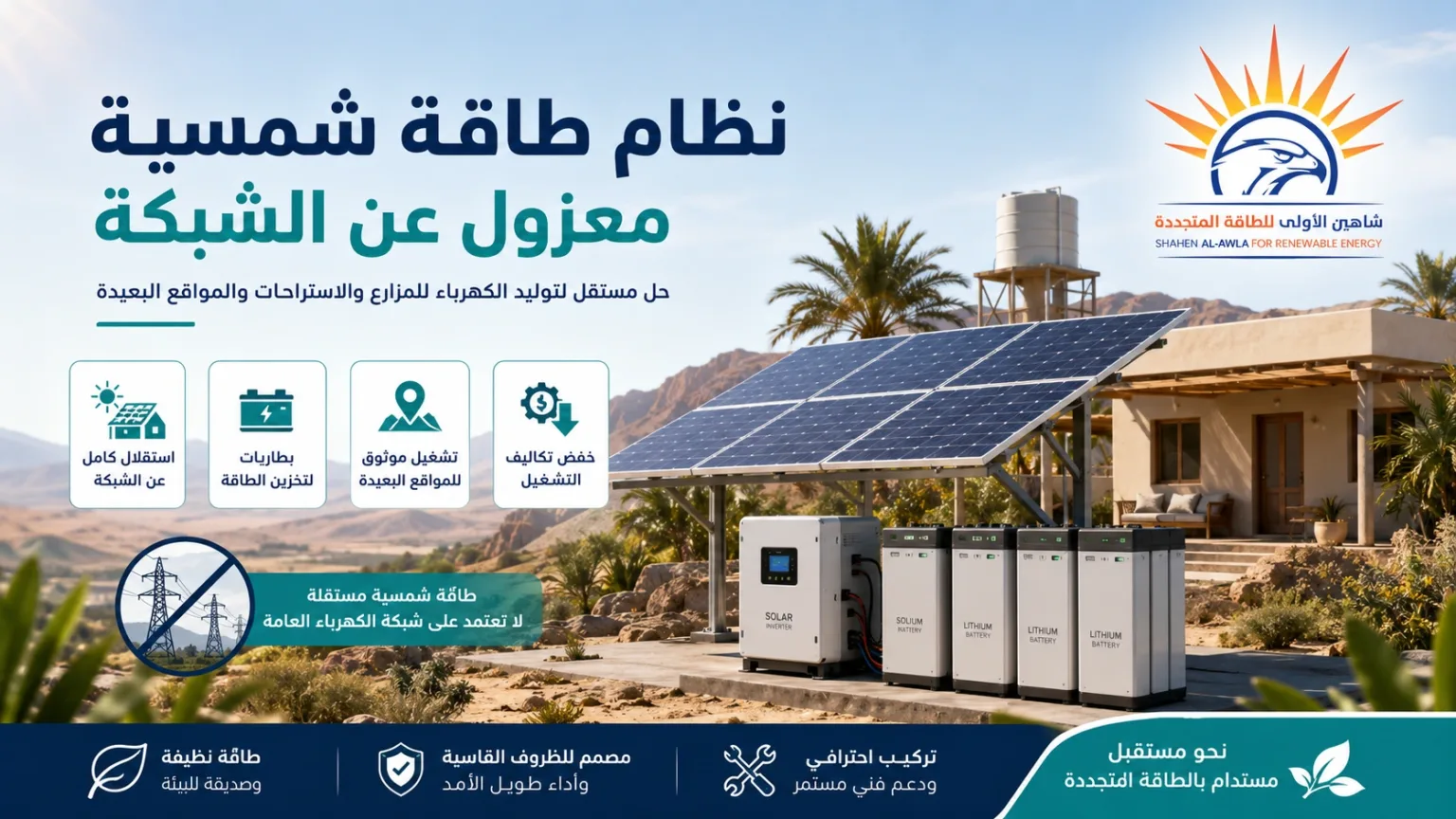
An off-grid solar power system operates completely independently of the public electricity grid. It generates power from solar panels during the day, then stores the surplus energy in batteries for use at night or when solar radiation drops.
This type of system doesn’t need a direct connection to the electricity company, which is why it’s widely used in remote areas or sites where running power lines is difficult. It’s also ideal for customers who want an independent power source they can fully control.
Components of an Off-Grid Solar Power System
An off-grid system is made up of several core elements, and each one must be chosen carefully to ensure efficient operation and stable performance.
1. Solar Panels
The panels are the component responsible for converting sunlight into electrical power. Their number and capacity are determined by daily consumption, the required operating hours, and the nature of the electrical loads.
The more efficient the panels, the more power the system can produce from a smaller footprint, which matters greatly at sites where installation space is limited.
2. Solar Batteries
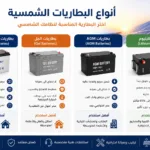
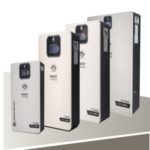
Batteries are the heart of an off-grid solar power system, because they store energy for use at night or during cloudy periods. Battery types vary between lithium, gel, and lead-acid, but lithium batteries have become the preferred choice in many projects thanks to their longer lifespan and higher efficiency.
Battery capacity is never chosen at random. It depends on the amount of energy required, the number of operating hours after sunset, and the level of safety the system needs.
3. The Inverter
The inverter converts the electricity stored in the batteries or generated by the panels from direct current (DC) into alternating current (AC) suitable for running appliances. Inverter quality directly affects the stability and efficiency of the system, so choosing a weak inverter simply to cut costs is not advisable.
4. Charge Controller
The charge controller manages the battery charging process and protects the batteries from overcharging and deep discharge. A suitable charge controller preserves battery life and reduces the likelihood of faults.
5. Mounting Structures, Cables, and Protection
The system also includes panel mounting bases, solar cables, breakers, protection devices, and junction boxes. These elements may seem simple, but they are essential for ensuring the safety, efficiency, and longevity of the system.
When Do You Need an Off-Grid Solar Power System?
You need this type of system when your site is far from the electricity grid, when the cost of connecting to power is high, or when you need an independent solution that isn’t affected by outages.
Its most common applications include:
- Farms and wells.
- Rest houses and campsites.
- Homes in remote areas.
- Communications and monitoring stations.
- Outdoor lighting systems.
- Running water pumps.
- Agricultural projects.
- Temporary or mobile sites.
- Guard rooms and remote warehouses.
If your site needs a steady supply of electricity and there’s no grid nearby, an off-grid solar power system may well be the most practical and sustainable solution.
The Difference Between Off-Grid and Grid-Tied Systems
It’s important to understand the difference before deciding to buy. A grid-tied system relies on the presence of public electricity and uses solar energy to reduce consumption drawn from the grid. An off-grid system, on the other hand, works independently and needs batteries to store energy.
The Grid-Tied System
- Requires the presence of an electricity grid.
- Usually doesn’t need batteries.
- Well suited to cutting your electricity bill.
- Often less expensive than an off-grid system.
- In some cases won’t operate during a grid outage without special equipment.
The Off-Grid System
- Doesn’t require an electricity grid.
- Relies on batteries.
- Well suited to remote sites.
- Provides complete independence.
- Requires precise design to cover the loads.
That’s why choosing an off-grid solar power system makes more sense when the priority is independence and securing electricity at a remote site.
How Is an Off-Grid System Designed?
Design is the most important stage, because any error in the calculations can lead to weak performance or batteries that drain too quickly. Correct design starts with knowing the electrical loads precisely.
Core Design Steps
- List every appliance that needs to run.
- Determine the power of each appliance in watts.
- Calculate the daily operating hours.
- Calculate total daily consumption in kWh.
- Determine the appropriate panel capacity.
- Determine the required battery capacity.
- Select the right inverter.
- Specify the cables and protection devices.
- Study the installation site and panel orientation.
- Put an operation and maintenance plan in place.
When an off-grid solar power system is built professionally, it’s able to meet actual demand without overspending or falling short on performance.
A Simple Example of Calculating Demand
Suppose you have a rest house that needs to run lighting, a fridge, a screen, a router, and a few small appliances. In this case, you calculate the consumption of each appliance, then add up the total daily consumption.
Illustrative example:
- Lighting: 300 watts for 6 hours.
- Fridge: 150 watts at average daily operation.
- Screen: 100 watts for 4 hours.
- Router: 20 watts for 12 hours.
- Additional appliances: 500 watts intermittently.
After the calculation, the size of the panels, batteries, and inverter is set based on actual consumption, with a suitable safety margin added. That’s why it’s impossible to pin down an exact cost for any off-grid solar power system without studying the site and the loads.
Advantages of the Off-Grid System
Choosing an off-grid system gives you several important advantages, especially at sites that rely on generators or struggle with connecting to power.
The key advantages:
- Complete independence from the electricity grid.
- Reduced reliance on fuel and generators.
- Stable operation at remote sites.
- Lower operating costs over the long term.
- An environmentally friendly solution.
- Well suited to farms, rest houses, and wells.
- The ability to expand in the future.
- Less noise compared to generators.
- Less maintenance than generators require.
- A permanent power source when designed correctly.
This is why the off-grid solar power system has become an important choice in Saudi Arabia, particularly for agricultural projects and outdoor sites.
Challenges to Keep in Mind
Despite the significant advantages, there are a few points you should understand before buying. An off-grid system requires careful study, because any reduction in the size of the batteries or panels can affect performance.
The main challenges:
- Higher upfront cost compared to some conventional solutions.
- The need for suitable batteries.
- The need to calculate loads precisely.
- The importance of regular maintenance.
- The effect of shade and dust on output.
- The need for technicians who specialize in installation.
- The need to choose high-quality components.
But with the right design, these challenges can be minimized and you can get the most out of an off-grid solar power system.
Is an Off-Grid System Suitable for Farms?
Yes. It’s considered one of the best solutions for farms, especially for running pumps, submersible pumps, and irrigation systems. In many agricultural areas the electricity grid is far away or unstable, which makes solar energy an economical and practical solution.
The system can be used for:
- Running water pumps.
- Running submersible pumps.
- Farm lighting.
- Powering workers’ quarters.
- Running monitoring systems.
- Running coolers or light equipment, depending on the design.
When designing an off-grid solar power system for farms, the focus should be on the pump’s operating hours, the depth of the well, the motor’s power, and the amount of water needed each day.
Is the System Suitable for Rest Houses and Campsites?
Rest houses and campsites are among the most fitting applications for off-grid systems. The system can run lighting, fridges, charging devices, screens, and some household loads according to the designed capacity.
But the loads must be defined precisely, especially if there are air conditioners, water heaters, or other high-consumption appliances. These loads require a larger system and stronger batteries, and can significantly affect the cost.
So before installing an off-grid solar power system for a rest house, you need to determine whether the goal is to run only essential loads or to power the entire site.
The Cost of an Off-Grid System
The cost of the system varies according to several factors, chief among them panel capacity, battery type, inverter size, component quality, and the nature of the installation. The presence of batteries makes an off-grid system more expensive than a grid-tied one, but in return it gives you complete independence.
Factors that raise or lower the cost:
- The number of solar panels.
- The type and capacity of the batteries.
- The inverter’s capacity.
- The quality of the cables and protection devices.
- The nature of the installation surface or ground.
- The number of operating hours required.
- The type of electrical loads.
- The need for future expansion.
- The project’s location and distance from the city.
That’s why you should treat the cost of an off-grid solar power system as a long-term investment, not merely an initial purchase price.
How Do You Choose the Right Company?
Choosing the company that carries out the work is no less important than choosing the components. An off-grid solar system requires a precise technical study and safe installation, not just mounting panels and batteries.
Before choosing a company, make sure of the following:
- Experience with off-grid systems.
- A clear load study.
- A clear explanation of the system’s capacity and expected output.
- The use of reliable components.
- Written warranties.
- Maintenance and technical support.
- An explanation of how to operate the system for the customer.
- A detailed proposal rather than just a lump-sum figure.
Shahen First Renewable Energy Company helps customers choose an off-grid solar power system based on a genuine study of the site, which reduces the chance of error and ensures the best possible performance.
Tips Before Buying a System
Before you decide to buy, follow these tips:
- Don’t buy a ready-made system without studying your needs.
- Calculate the loads precisely.
- Don’t cut battery capacity just to lower the price.
- Choose an inverter suited to high loads.
- Make sure the cables and protection devices are of good quality.
- Allow for future expansion.
- Avoid installing panels in places with shade.
- Ask about maintenance and cleaning.
- Request a clear warranty on the components.
- Make sure the system suits the Saudi environment.
Following these tips helps you get an off-grid solar power system that runs efficiently and serves you for many years.
Common Mistakes During Installation
Among the mistakes some customers make:
- Relying on a random number of panels.
- Ignoring the calculation of night-time consumption.
- Using fewer batteries than required.
- Installing panels in an unsuitable orientation.
- Buying unknown components.
- Not installing sufficient electrical protection.
- Ignoring dust and cleaning.
- Leaving no ventilation space around the batteries and inverter.
- Running loads greater than the system’s capacity.
- Not monitoring the system’s performance after installation.
These mistakes can make an off-grid solar power system less efficient and increase the likelihood of faults, which is why you should rely on specialized installation from the very start.
Maintenance and Extending Service Life
Regular maintenance helps preserve the system’s performance and reduce faults. Although solar systems don’t require complex maintenance like generators do, they still need regular follow-up.
The most important maintenance tasks:
- Cleaning dust off the panels.
- Inspecting cables and connections.
- Reviewing battery performance.
- Monitoring inverter readings.
- Making sure no new shade has appeared.
- Checking breakers and protection devices.
- Monitoring daily consumption.
- Not loading the system beyond its capacity.
The more regularly an off-grid solar power system is maintained, the greater its efficiency and the longer it keeps running at peak performance.
Why Shahen First Renewable Energy Company?
Shahen First Renewable Energy Company offers specialized solutions in the field of solar energy, covering site study, load calculation, system design, component supply, installation, commissioning, and maintenance. The company focuses on providing practical solutions that suit the needs of homes, farms, rest houses, and facilities.
The advantages of working with Shahen:
- Custom design based on the customer’s needs.
- Solutions for both off-grid and grid-tied systems.
- Supply of reliable components.
- Experience running submersible pumps on solar power.
- Technical support and maintenance.
- A clear study before implementation.
- Solutions suited to the environment of the Kingdom.
If you’re looking for an off-grid solar power system for your site, Shahen helps you choose the right capacity and avoid unnecessary costs.
An off-grid solar power system is an ideal solution for remote sites, farms, rest houses, wells, and projects that need an independent, reliable source of electricity. The success of such a system depends on correct design, choosing the right components, calculating loads precisely, and having the installation carried out by a specialist.
And with Shahen First Renewable Energy Company, you can get a complete solution that starts with consultation and technical study and runs all the way through installation and support, ensuring you an effective system that suits your needs and gives you genuine independence in producing your own power.
Frequently Asked Questions
Does an off-grid solar power system work at night?
Yes, an off-grid system works through the night thanks to the solar batteries that store the energy produced by the panels during the day. The number of operating hours depends on the battery capacity and the level of electricity consumption.
What’s the difference between an off-grid solar power system and a grid-tied one?
An off-grid system works independently and doesn’t need the electricity grid, relying on batteries to store energy. A grid-tied system, by contrast, relies on public electricity and usually doesn’t need batteries; it’s used to reduce electricity consumption and lower the bill.