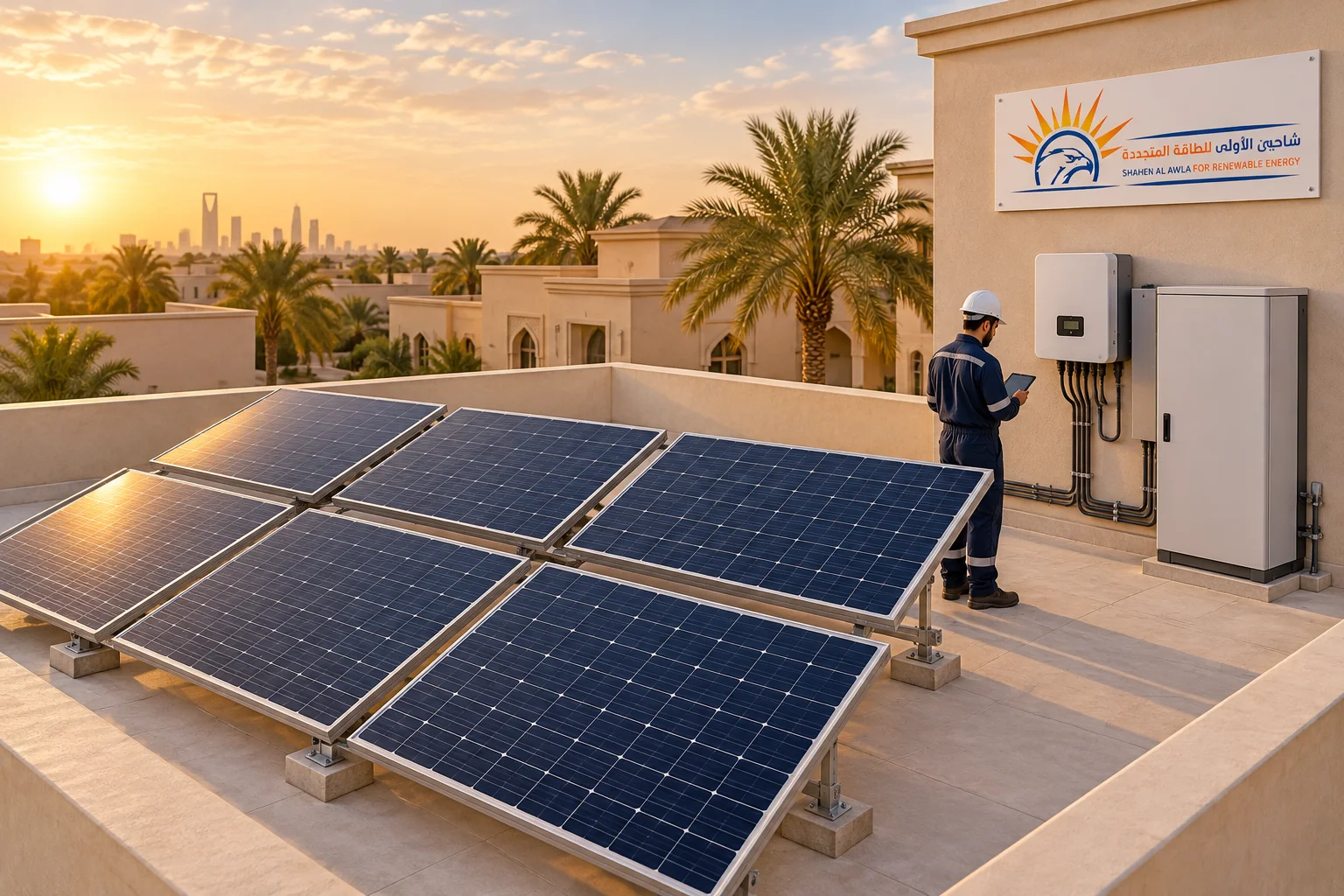
Choosing the right solar panel sizes is an essential step before designing any solar system, because a panel’s dimensions directly affect how many panels can be installed, the space required, how they’re laid out, and the system’s final capacity. Shahen helps its customers choose suitable panels after studying consumption, space, and site conditions, instead of relying on power or price alone.
What Does Solar Panel Size Mean?
Solar panel sizes refer to a panel’s actual external dimensions, meaning its length, width, and thickness, not its electrical power in watts. So you may find two panels with similar power but different dimensions, because of differences in the number of cells, manufacturing technology, efficiency, and frame design.
There is no single size that suits all panels or projects; panels used on homes may differ from the high-power panels used on farms, in factories, and at commercial facilities.
Shahen starts system design by studying consumption and the site before specifying components, since the right capacity and space vary from one project to another.
What’s the Difference Between a Panel’s Size and Its Power?
One of the most common mistakes is confusing solar panel sizes with panel power. When a panel is described as 450 or 550 watts, that refers to its rated electrical power, not its external size.
In other words:
- Size: panel length × width × thickness.
- Power: the rated energy the panel can produce under standard test conditions.
- Efficiency: how well the panel converts the solar radiation falling on its area into electricity.
- Number of cells: affects the panel’s design, dimensions, and voltage.
- Weight: important when assessing roof capacity and mounting structures.
That’s why choosing the highest available power isn’t enough; the panel may be too large for the space or unsuitable for the roof layout.
Solar Panel Sizes by Power Rating
Solar panel sizes vary from one manufacturer to another even when the power is the same, so always check the model’s datasheet before designing.
Broadly, panels can be divided into several categories:
Small Solar Panels
These are usually used in simple applications, such as:
- Small lighting systems.
- Charging some batteries.
- Portable systems.
- Solar-powered cameras or devices.
- Camping and small-site applications.
They’re easy to transport and install, but they aren’t usually used as a main component in large systems.
Medium-Power Panels
Medium panels are used in many residential and small commercial projects, especially when the goal is to use space flexibly.
When comparing solar panel sizes in this category, note that higher cell efficiency can deliver more power without a large increase in panel area.
Around 450-Watt Panels
This is one of the common power ratings in many solar applications, and its size varies with the manufacturer and cell technology.
Shahen’s articles on panel prices note that a range of ratings is available, such as 450 W, 550 W, and higher, and that the choice should be based on site space and system needs, not the power figure alone.
550-Watt Panels and Above
High-power panels have become common in projects that need more output with fewer panels, such as:
- Farms.
- Factories.
- Warehouses.
- Commercial facilities.
- Water pumping projects.
- Larger solar plants.
High-power solar panel sizes are often larger than lower-power panels, but they can reduce the number of units needed to reach the same total capacity.
Are There Fixed Dimensions for a Solar Panel?
There are no standard dimensions that apply to every product, so it’s wrong to rely on a fixed figure when working out solar panel sizes.
Dimensions vary according to:
- The manufacturer.
- The number of cells.
- The cell shape.
- Half-cut or similar modern technologies.
- The panel’s rated power.
- Frame thickness.
- Cell efficiency.
- The design of the panel itself.
That’s why the engineer should rely on the technical datasheet of the actual product before deciding where to mount it.
Why Does Panel Size Matter When Designing a System?
Knowing solar panel sizes is important because it directly determines how much space the system will take up.
For example, if a project needs 20 panels, calculating the area of one panel and multiplying it by 20 isn’t always enough, because the design also needs to account for:
- Spacing between panels.
- Maintenance walkways.
- Distance from the building’s edges.
- Shaded areas.
- Panel orientation.
- Tilt angle.
- The position of AC units and tanks.
- Roof openings.
- The metal structure and mounting bases.
So the space actually required can be larger than the combined area of the panels.
How to Calculate a Solar Panel’s Area
If you know the length and width, you can easily calculate a panel’s area:
Panel area = length × width
If a panel is about 2.2 meters long and about 1.1 meters wide, its approximate area is:
2.2 × 1.1 = 2.42 square meters
But this is just a worked example, not a fixed size for all panels.
When studying solar panel sizes for a real project, always use the product dimensions given in the technical specifications.
How to Calculate the Panel Area a System Needs
You can make a preliminary estimate with these steps:
- Define the required system capacity.
- Define the power of the panel you’re considering.
- Divide the system capacity by the panel power to get the approximate number.
- Calculate the area of one panel.
- Multiply the panel area by the number of panels.
- Add the spacing needed for installation, movement, and maintenance.
If you don’t know the right capacity in the first place, it’s better to start by calculating consumption instead of choosing a random number of panels.
Shahen offers design and consulting services that start by reviewing the site’s consumption, then defining the type of system, its capacity, and suitable components.
Solar Panel Sizes for Homes
In residential projects, choosing solar panel sizes depends heavily on the shape of the roof, not just its total area.
You may have a large roof, but it may have:
- Water tanks.
- AC units.
- High walls.
- Service rooms.
- Shaded areas.
- Antennas or other equipment.
So the usable area is identified first, then several panel layouts are tested to find the most efficient design.
You can read our guide to home solar installation in Saudi Arabia to learn about the components and steps that come before installing a residential system.
Is a Bigger Panel Better for Homes?
Not always.
Large, high-power panels can be excellent for reducing the number of units, but the roof design may make a set of smaller panels more flexible.
So the best solar panel sizes for a home are the ones that make the most of the available space while reducing shading and keeping maintenance easy.
For example, a narrow part of the roof may not fit a large panel but may take a smaller one, which in some cases can increase the total capacity that can be installed.
Solar Panel Sizes for Farms
On farms, space is often less restricted, so higher-power, larger panels can be used.
When choosing solar panel sizes for farms, consider:
- The land area set aside for panels.
- Wind strength.
- Soil type.
- Water pump capacity.
- Operating hours.
- The direction of panel rows.
- Row spacing to prevent shading.
- Access for workers and maintenance equipment.
Shahen also provides solar solutions for farms and pumps, with the system designed around the pump’s capacity, the well depth, and actual loads.
Panel Sizes for Submersible Pump Systems
In well pump systems, panels aren’t chosen on space alone; the design starts with the pump.
You need to know:
- The pump’s power.
- Voltage.
- The required water flow rate.
- Well depth.
- Operating hours.
- The pump inverter’s capacity.
- The energy needed over the day.
Then the number and power of the panels are determined, followed by the solar panel sizes that suit the structure and available space.
Shahen offers solar submersible pump systems as part of its solutions for agricultural projects.
How Panel Efficiency Affects Size
Efficiency is a very important factor when comparing two panels of the same power.
If two panels have the same power and the first is more efficient, it may deliver the required power from a smaller area.
So assessing solar panel sizes should include:
- Power in watts.
- Area in square meters.
- Panel efficiency.
- Expected production.
- Performance at high temperatures.
- Warranty.
It’s a mistake to buy a panel just because it’s smaller without checking its power, efficiency, and electrical specifications.
Does the Number of Cells Determine Panel Size?
The number of cells clearly affects the design, but it isn’t the only factor.
Panels come in different designs using full or half cells, and the way cells are arranged inside the panel has evolved.
So it can’t be said that every panel with a certain number of cells has the same dimensions.
That’s why the correct reference for solar panel sizes remains the technical datasheet of the model you’re buying.
How Much Space Does a 5kW System Need?
An exact area can’t be given without knowing the panel’s power and dimensions, but it’s easy to calculate once the model is chosen.
For example:
If you use 500-watt panels, a 5 kW system theoretically needs:
5,000 ÷ 500 = 10 panels
Then multiply the number of panels by the area of one panel, and add suitable space for gaps and maintenance.
This clearly shows why solar panel sizes affect the final area even when the system capacity is the same.
What About a 10kW System?
In the same way, with 500-watt panels:
10,000 ÷ 500 = 20 panels
Using a higher-power panel may reduce the number of panels.
But that doesn’t necessarily mean the area will shrink by the same proportion, because higher-power panels are often physically larger too.
So the comparison is based on:
Panel power ÷ panel area
not on power alone.
How Panel Size Relates to Solar Prices
Panel prices vary with power, technology, efficiency, manufacturer, and other factors, not with size alone.
So solar panel sizes may be similar between two products while the price differs because of:
- Cell efficiency.
- Brand.
- Warranty.
- Manufacturing technology.
- Panel power.
- Temperature coefficient.
- Overall quality.
You can read our guide to solar panel prices in Saudi Arabia to learn about the main factors that determine the price of a panel and a system.
How Does Size Affect Mounting Structures?
Whenever solar panel sizes change, the distribution of mounting points and the loads on the structure change too.
So mounting bases should be chosen based on:
- Panel dimensions.
- Weight.
- Horizontal or vertical orientation.
- The number of panels per row.
- Wind conditions.
- Type of roof or ground.
- Tilt angle.
It isn’t advisable to use a mounting design built for one model with a different panel without reviewing the dimensions and structural specifications.
You can visit the Shahen solar store to see the system products and accessories available.
Landscape or Portrait Mounting?
Panels can be mounted in portrait or landscape orientation depending on the site design.
The orientation doesn’t affect the panel’s power, but it does affect how solar panel sizes are distributed across the roof.
Portrait Mounting
May suit spaces that allow long rows with limited width.
Landscape Mounting
May be more suitable for some low roofs or where there are certain obstacles.
The designer chooses the right orientation after drawing the roof and the positions of obstacles and shading.
How to Measure Your Roof Before Buying Panels
You can do a preliminary check, but the final design is best done by a specialist.
Start by measuring:
- Roof length.
- Roof width.
- Tank positions.
- AC units.
- Rooftop rooms.
- High walls.
- Any areas exposed to shading.
- Access points and maintenance walkways.
Then compare the net area with the solar panel sizes you’re considering.
Remember that leaving suitable space around the panels may be necessary for maintenance and safety.
Factors More Important Than Size Alone
Although dimensions matter, a system shouldn’t be chosen on them alone.
Before buying panels, also compare:
- Panel efficiency.
- Rated power.
- Temperature coefficient.
- Product warranty.
- Performance warranty.
- Voltage and current.
- Compatibility with the inverter.
- Build quality.
- Weather resistance.
Shahen provides solutions that include feasibility studies, design, supply of compatible components, and installation and commissioning, which helps you choose panels as part of a complete system instead of choosing each component separately.
Choosing Sizes for Off-Grid Systems
In an off-grid system, the number of panels is set according to the required consumption, operating hours, and battery capacity.
Shahen’s off-grid systems combine panels, inverters, and storage batteries, with system capacity defined by the loads and daily operating hours.
Once the required number is set, solar panel sizes come into play to make sure all the panels fit within the available space.
You can learn more about off-grid systems before designing your project.
For more on solar batteries in Saudi Arabia.
Common Mistakes When Choosing Panel Sizes
Avoid the following mistakes:
- Buying panels before measuring the site.
- Relying on power alone.
- Assuming all 550-watt panels have the same dimensions.
- Ignoring panel weight.
- Not allowing for maintenance spacing.
- Filling the entire roof without considering shading.
- Ignoring the positions of tanks and AC units.
- Buying panels that aren’t electrically compatible with the inverter.
- Not assessing the strength of the mounting structures.
- Relying on an approximate size instead of the datasheet.
These mistakes can lead to buying panels that can’t be laid out efficiently on the site.
How to Choose the Best Panel for Your Project
To choose the right solar panel sizes, follow this sequence:
- Calculate your consumption or the required loads.
- Define the system capacity.
- Choose the system type: on-grid, off-grid, or hybrid.
- Measure the available space accurately.
- Identify areas unsuitable for installation.
- Compare several panels on power, efficiency, and dimensions.
- Calculate the number of panels.
- Try out the panel layout on a site plan.
- Check voltage and current compatibility with the inverter.
- Choose mounting structures suited to the dimensions and weight.
This approach helps you choose a panel on an engineering basis instead of relying on price or power alone.
Why Shahen?
When choosing solar panel sizes, you don’t just need a panel seller; you need a provider that can link panel dimensions to the site’s space, the system’s capacity, and the project’s consumption.
Shahen First Renewable Energy offers services that start with a needs study and site survey, followed by engineering design, component supply, installation, commissioning, and follow-up. Its solutions also include on-grid and off-grid systems, submersible pump systems, and solar component supply.
You can also visit the Shahen store when looking for solar components and products suited to your system.
Summary
Choosing the right solar panel sizes helps you make better use of your roof or land and accurately determine the number of panels, space, and mounting structures required. There are no single dimensions that suit every project, or even every panel of the same power.
Always start by calculating the project’s needs, then define the available space and compare panels on power, efficiency, dimensions, weight, and electrical specifications.
With Shahen, you can get a study and design that take into account the site and consumption, then choose compatible panels and components and have the system installed as a complete package.
Frequently Asked Questions
Does panel weight affect the design?
Yes. The weight of the panels and structures must be considered when installing a system on a roof, along with wind conditions, the type of building, and the mounting method.
Where can I buy solar panels and components from Shahen?
You can learn about Shahen’s solutions on its website, and visit the Shahen solar store to see the products and components available for your system.