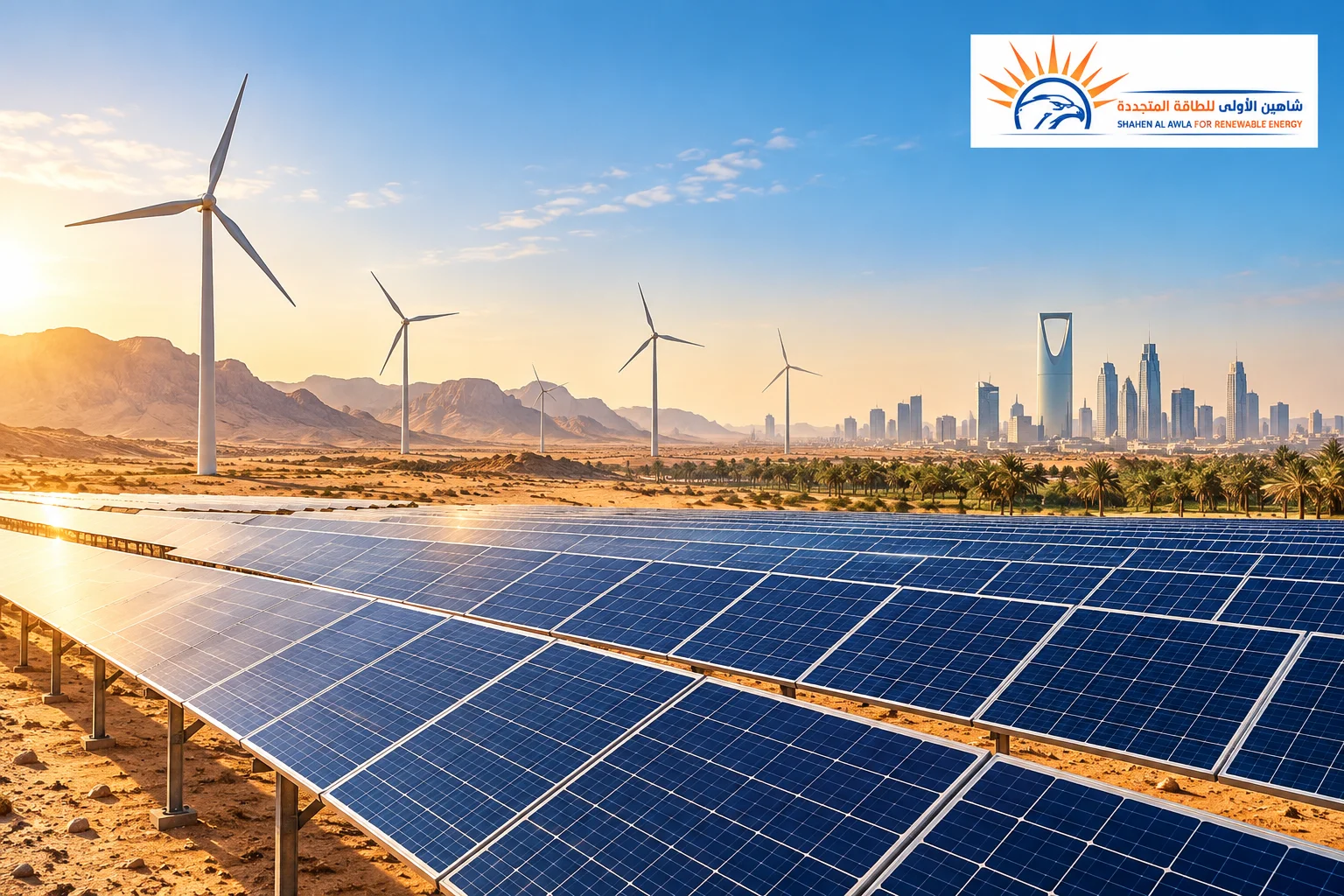
Renewable energy in Saudi Arabia opens up opportunities to diversify electricity sources and put natural resources to work for homes, businesses, and farms. Shahen provides specialized solar energy solutions covering study, design, supply, installation, and maintenance. With so many technologies and applications, understanding the difference between renewable sources and the systems that use them is an essential step before deciding to build anything. The right project for a grid-connected home is different from a system that runs a farm pump or powers a remote rest house. This guide covers the types, benefits, and uses of renewable energy, then explains how to move from general knowledge to studying your own needs and choosing a solution that fits the Saudi market.
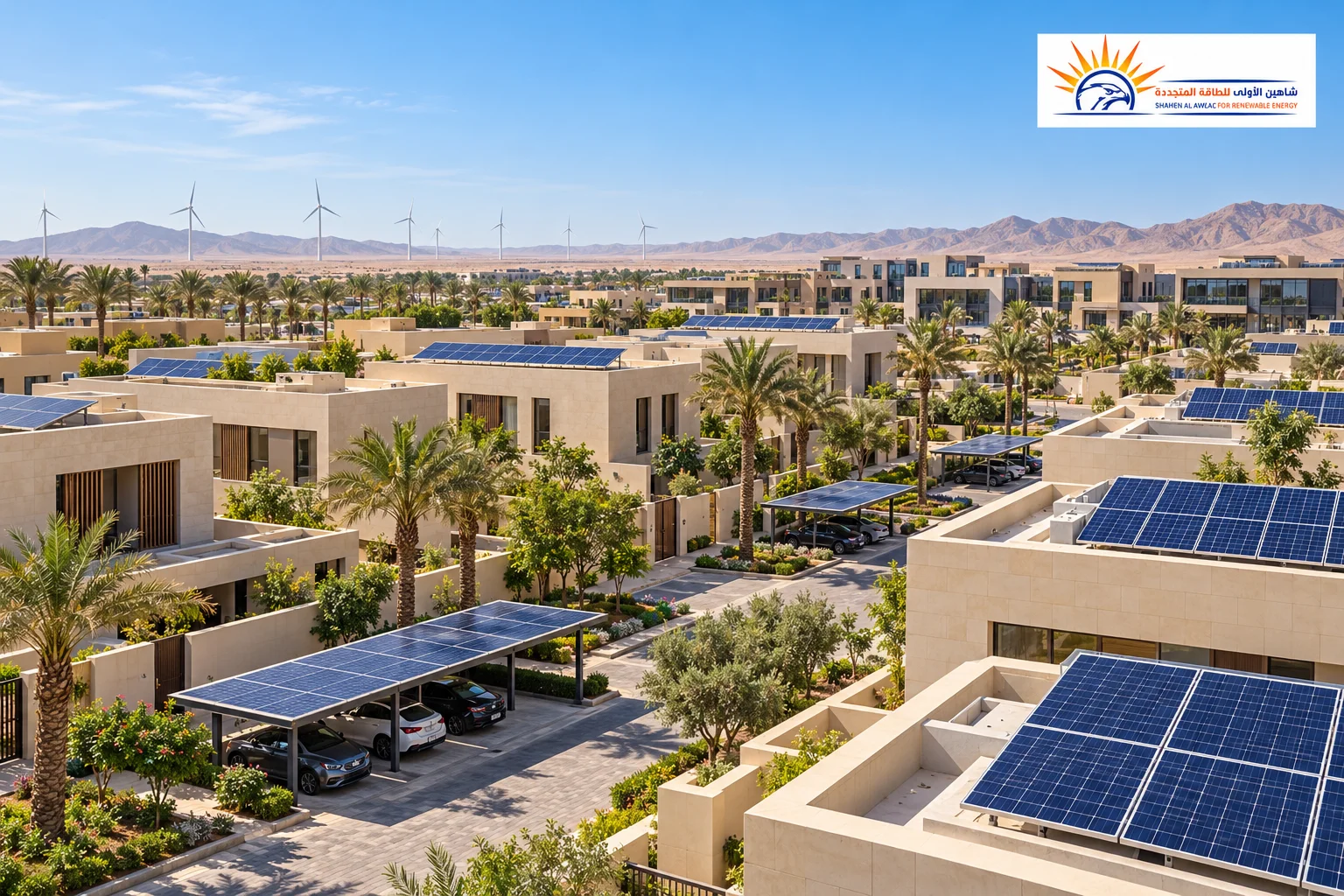
Renewable Energy in Saudi Arabia
Renewable energy in Saudi Arabia means using naturally replenishing sources, such as solar radiation and wind, to produce electricity, heat, or other forms of energy.
It’s important to distinguish between the source, the technology, and the application: the sun is the source, photovoltaic panels are the conversion technology, and lighting a home or running a pump is the end application.
A battery is a way to store energy, not a renewable source in itself. This understanding helps you read system quotations correctly and know what each component does.
Types of Renewable Energy in Saudi Arabia
Discussions of renewable energy in Saudi Arabia cover several sources, but how suitable they are and how widely they are used depends on the natural resource, the location, and feasibility.
| Type | How it is used | What determines suitability? |
|---|---|---|
| Solar energy | Producing electricity or heat | Irradiation, space, and technology |
| Wind energy | Converting air movement into electricity | Wind speed and distribution |
| Bioenergy | Using suitable organic materials and waste | Resource availability and processing technology |
| Geothermal energy | Using heat from beneath the earth’s surface | Geological characteristics and technical study |
Solar and wind stand out in official Saudi projects, while other sources need a specific assessment for each application.
The National Program and Major Projects
The development of renewable energy in Saudi Arabia is tied to initiatives to diversify generation sources and develop the sector. The Ministry of Energy presents the National Renewable Energy Program and its projects, including the Sakaka solar power plant and the Dumat Al-Jandal wind farm.
These projects show how utility-scale generation differs from systems installed on a building or within a farm: each level has different design, operating, and investment requirements.
When reading the news, distinguish between projects that have been announced, those that have been contracted, and those that are actually operating.
For more on applications and project stages, read our article on solar energy projects in Saudi Arabia.
Solar Energy in Saudi Arabia
Solar power is one of the most important applications of renewable energy in Saudi Arabia. Photovoltaic panels convert solar radiation into electricity that can be used at many kinds of sites.
But abundant sunshine doesn’t mean constant output: performance is affected by heat, shading, orientation, tilt, dust, and equipment losses. That’s why production must be estimated based on the site and the design.
Choosing a high-wattage panel isn’t enough without checking its efficiency, dimensions, warranty, and compatibility with the rest of the system.
For more on technologies and specifications, read our guide to the best types of solar panels in Saudi Arabia.
Wind Energy: When Is It Suitable?
Wind adds diversity to the sources of renewable energy in Saudi Arabia, but choosing a generation site requires data on wind speed, consistency, direction, and terrain.
Noticeable wind at a site is not enough to prove that a turbine is worthwhile. The requirements of large projects also differ from those of small turbines near buildings, where obstacles and turbulence affect performance.
Wind solutions should therefore be treated as projects that need their own study; they shouldn’t replace panels or be added to a solar system without an engineering assessment.
Uses of Renewable Energy
The uses of renewable energy in Saudi Arabia vary with the size of the project and the user’s needs, including:
- Generating electricity at power plants that feed the grid.
- Helping supply homes and businesses.
- Running water pumps and submersible pumps.
- Providing electricity to remote sites.
- Lighting some pathways and outdoor areas.
- Producing heat with suitable technologies.
Choosing an application starts with defining the service you need: electricity for appliances, water pumping, or heating? Then the technology and equipment are selected, instead of buying components and then trying to find a use for them.
Residential Applications
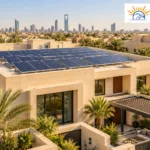
Homes can benefit from renewable energy in Saudi Arabia through solar systems that cover part of their consumption or specific loads, depending on the design.
Before installing, gather your electricity bills and identify when you use the most power, especially for air conditioning. Then decide whether your goal is to buy less from the grid during the day, have backup power, or run a home that isn’t connected to the grid.
Each goal changes the choice of inverter, batteries, and protection, and installing panels does not automatically keep the power on during a grid outage.
For more on residential solutions, read our article on home solar installation in Saudi Arabia.
Agricultural Applications
Renewable energy in Saudi Arabia offers opportunities to power some agricultural loads, but water demand and operating patterns shape the design more than the size of the farm alone.
Pump power, flow rate, head, and irrigation hours must be studied, along with whether a grid connection or backup source is available. For some applications, storing water in a tank can be a better choice than storing electricity, depending on the technical study.
A grid-connected farm needs its consumption and load timing assessed before the capacity is decided.
For more on budgets and the factors that affect them, read our article on the cost of solar energy for farms.
Running Submersible Pumps and Pumping Water
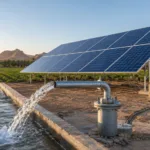
One practical application of renewable energy in Saudi Arabia is running submersible pumps with solar systems designed around the pump, the well, and the water demand.
Deciding the number of panels from the power rating on the pump alone is not enough: the voltage, starting method, operating point, total head, and flow rate all need to be reviewed.
A direct pumping system also differs from a system that supplies general household loads, and it may need a pump inverter, protection, and controls suited to the operating conditions.
For more on design and operation, read our guide to running submersible pumps on solar power.
Factories, Warehouses, and Commercial Facilities
Facilities can benefit from renewable energy in Saudi Arabia through solar systems matched to their consumption pattern, especially where there are daytime loads and suitable space.
But assessing feasibility requires the load profile, roof condition, shading, cable routes, and expansion plans. The structure must also be checked to make sure it can carry the mounting system before relying on the available roof area.
Ask for a study showing the expected production and how much of it will actually be consumed, keeping estimated savings separate from any promises not based on the project’s data.
For more, read our article on on-grid solar systems for factories and warehouses.
Benefits of Renewable Energy
The benefits of renewable energy in Saudi Arabia include diversifying supply sources, using local resources, and offering options to power different sites and loads.
A suitable system can help reduce purchased electricity or fuel, but the amount saved depends on cost, operation, and actual production.
From an environmental perspective, the impact should be assessed over the equipment’s whole life cycle, including manufacturing, transport, use, and handling components at the end of their life. Calling a technology renewable does not mean it has no environmental impact.
The Main Components of a Solar System
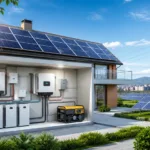
When renewable energy in Saudi Arabia is applied using the sun, the equipment usually includes panels, an inverter, mounting structures, cables, and protection devices, with batteries and charge controllers added when needed.
The quality of the result depends on how well these elements work together, not on the quality of one part alone. The inverter needs suitable voltage and current limits, and the battery needs compatible charge and discharge settings.
Ask for a clear list of models and specifications, and make sure the offer includes installation, testing, and all necessary accessories.
For more on what each element does, read our guide to solar system components.
Choosing the System Type and Inverter
End-user solutions for renewable energy in Saudi Arabia vary depending on whether a grid is available and whether storage and backup are needed.
A grid-tied system makes use of solar production alongside the grid, while an off-grid site needs a balance between loads, production, and storage. A hybrid system can combine several sources, depending on what its equipment supports.
Define the inverter’s required function before comparing prices, especially if you have sensitive loads or need power during outages.
For more on the differences, read our article on types of solar inverters.
The Role of Batteries in Energy Storage
Storage becomes more important in renewable energy in Saudi Arabia applications when the timing of production doesn’t match consumption, or when specific loads need to be powered later.
But batteries don’t increase panel production; they store part of the energy, with some losses. Their capacity is calculated from the loads, operating duration, depth of discharge, efficiency, and a design margin.
Also check the discharge rate, compatibility, temperature conditions, and warranty instead of relying on the capacity figure alone.
For more on comparing options, read our guide to types of solar batteries.
How Do You Start Studying Your Project?
Start a renewable energy in Saudi Arabia project by defining your goal and gathering real data, then move on to the site survey and design.
Prepare the following information:
- The project location and type of building.
- Electricity bills or load data.
- Daily hours of use.
- Photos of the available space and any obstacles.
- Whether you need night-time or backup operation.
- Possible future expansion.
At remote sites, pay attention to the lowest-production periods and the required autonomy, not just an average sunny day.
For more on this application, read our guide to off-grid solar power systems.
Cost and Financial Feasibility
The feasibility of renewable energy in Saudi Arabia projects depends on the initial investment, how much of the production is used, and operating, maintenance, and replacement costs.
Compare offers on the same basis, covering equipment, mounting, protection, installation, testing, warranty, taxes, and exclusions. Don’t confuse the price of a panel with the cost of a complete project.
Ask for the savings assumptions to be explained, and don’t assume you will be paid for surplus energy without confirming the connection and contract terms for your project.
For more on budget items, read our article on the cost of home solar installation in Saudi Arabia.
How Do You Choose an Installer?
A successful renewable energy in Saudi Arabia project needs a provider that understands your loads and offers a clear design, specifications, and scope of work, with follow-up after commissioning.
Ask about experience with similar projects, how production is estimated, who is responsible for grid-connection procedures, and the warranty and maintenance terms. Ask for handover documents and an explanation of monitoring and alerts.
Shahen’s published services include the study, design, supply, installation, and maintenance of solar systems, with each solution defined by the site’s needs.
For more on how to compare providers, read our guide to the best solar installation company in Saudi Arabia.
The Future of Renewable Energy in Saudi Arabia
The future of renewable energy in Saudi Arabia is linked to the development of generation, grids, storage, technical skills, and supply chains, along with better management of consumption.
Monitoring and control technologies make it possible to assess performance more precisely, while advances in equipment widen the range of design options. But buying the latest technology does not guarantee feasibility without a clear need.
For the end user, the practical step is still to choose a project that can be measured and monitored, and to check official updates when making decisions about grid connection or contracts.
To get started, gather your site and load data, then contact Shahen to request a study and a quotation that sets out the proposed solution, components, cost, and warranty.
Frequently Asked Questions
Is solar energy the only renewable source?
No. Renewable energy in Saudi Arabia includes solar and wind, and other sources are considered depending on resources, feasibility, and the nature of the application.
Does every solar system need batteries?
No. The need for storage depends on the system type, when energy is consumed, and the goal of the project.