A 100W solar panel is worth considering for small loads such as lighting, charging devices, and running some camping equipment, and you can ask Shahen about compatible components and whether the capacity you need is available. But how useful the panel is depends on the energy it produces over the day, how much your devices consume, and how the power is stored and converted. That’s why the wattage figure alone isn’t enough before you buy. In this guide for the Saudi market, we explain suitable uses, estimated output, choosing the battery and charge controller, and the factors that determine the cost of a small system.
What Does a 100W Solar Panel Rating Mean?
The rating of a 100W solar panel refers to its maximum rated power measured under specific standard test conditions; it is not a fixed output at all times.
Actual output changes with solar radiation, cell temperature, orientation, shading, and how clean the surface is. Voltage and current characteristics also differ between models, even when their rated power is the same.
That’s why you should check the datasheet and make sure the stated power belongs to the panel itself and isn’t a marketing description of a complete system.
For more on what’s inside a panel, read our article on what solar panels are made of.
The Difference Between Power and Daily Energy
When evaluating a 100W solar panel, distinguish between watts and watt-hours. Watts measure instantaneous power, while watt-hours measure the amount of energy produced or consumed over a period.
A device that draws 10 watts for five hours needs 50 watt-hours. A panel doesn’t produce its rated power through all daylight hours, so peak sun hours and losses are used to estimate daily energy.
This step stops you from expecting to run large appliances based on the power rating alone.
How Much Does It Produce Per Day in Saudi Arabia?
You can make a preliminary estimate of a 100W solar panel‘s output with this formula:
Daily energy = panel power × peak sun hours × performance ratio.
Assuming five peak sun hours and a 75% performance ratio:
100 × 5 × 0.75 = 375 watt-hours per day.
This is an illustrative calculation, not a guaranteed average for Saudi cities. The energy available to your devices may be lower still once storage and inverter losses are added, if they weren’t included in the ratio used.
Which Devices Can It Run?
A 100W solar panel can support small loads through a compatible system that includes charge control and storage where needed. The table shows assumed consumption for some devices:
| Device | Usage assumption | Energy required |
|---|---|---|
| Two LED bulbs | 5 W per bulb × 5 hours | 50 Wh |
| Router | 10 W × 6 hours | 60 Wh |
| Laptop | 45 W × 2 hours | 90 Wh |
| Small fan | 15 W × 4 hours | 60 Wh |
The total is 260 Wh before supply losses, and you should use data from your actual devices.
For more on applications, read our article on solar-powered products.
Is It Suitable for a Refrigerator or Air Conditioner?
A single 100W solar panel is not a practical option for powering a household air conditioner, and running a refrigerator can’t be guaranteed based on the panel’s power alone.
Check the refrigerator’s daily consumption and the compressor’s starting requirements, then compare them with the system’s output, battery capacity, and inverter power. Some small, highly efficient appliances may suit specific applications, but that needs its own calculation.
To run several household loads, studying a larger system makes more sense than trying to push a small panel beyond its capabilities.
Voltage and Current: What to Check
Before buying a 100W solar panel, check four key values on the datasheet:
- Vmp: operating voltage at maximum power.
- Imp: operating current at maximum power.
- Voc: open-circuit voltage.
- Isc: short-circuit current.
A panel described as suitable for a 12-volt battery system doesn’t have a fixed 12-volt output. These values must be matched to the charge controller’s limits, taking into account how voltage changes with temperature.
Available Types and How to Choose
A 100W solar panel can come as a rigid, flexible, or foldable design, and each has its own considerations for mounting, transport, ventilation, and durability.
A rigid panel suits fixed installation when a suitable mount is available, while a foldable one is easier to carry. A flexible panel requires strict adherence to the bending limits and mounting method specified by the manufacturer.
Compare efficiency, weight, warranty, and connectors, and don’t assume all panels are equal just because they have the same rating.
For more on technologies, read our guide to the best types of solar panels.
What Size and Space Do You Need?
The dimensions of a 100W solar panel vary with cell efficiency and product design, so there is no standard size for this rating.
Before ordering, measure the mounting space or storage and transport space, and check the panel’s weight, the position of the mounting holes, and the cable length. Leave enough room for ventilation and access to the connectors.
Don’t use another model’s dimensions to prepare the mount, even if it has the same rating; small differences can affect stability and ease of use.
For more on dimensions, read our article on solar panel sizes.
Components Needed to Build a Small System
A 100W solar panel on its own isn’t enough to power every device reliably. The components needed depend on the device, but may include:
| Component | Function |
|---|---|
| Charge controller | Manages battery charging |
| Battery | Stores energy for later use |
| DC-DC converter | Provides a suitable voltage for DC devices |
| Inverter (if needed) | Powers AC devices |
| Cables and protection | Safe connections according to the design |
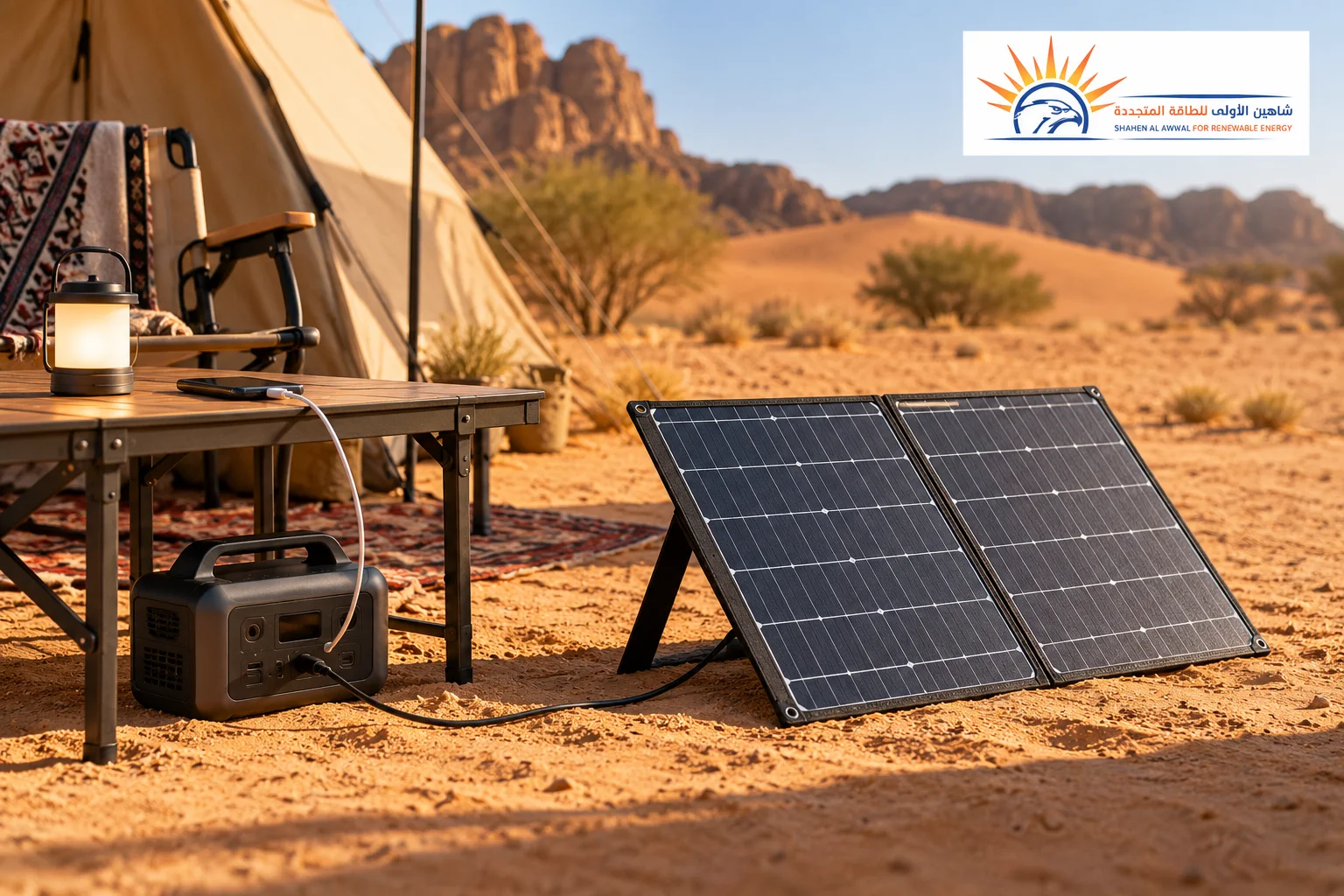
A portable power station may include some of these functions, provided its solar input is compatible with the panel.
For more, read our guide to solar system components.
How to Choose the Charge Controller
The controller for a 100W solar panel should be chosen according to the battery voltage, the panel input limits, the charging current, and the battery type.
MPPT can be a good choice for making use of the voltage difference within its conditions, while PWM may suit some simple, compatible systems. But the choice doesn’t depend on the technology name alone.
Also check the minimum voltage needed to start charging, the battery settings, and the design margin. Don’t connect the panel directly to a battery without proper charge control.
For more on comparing them, read our article on solar charge controllers.
Calculating the Right Battery
The battery for a 100W solar panel depends on the energy you need and how long you need it. Example: to supply loads that need 200 Wh, assuming 90% supply efficiency and 80% usable battery capacity:
Approximate nominal capacity = 200 ÷ (0.9 × 0.8) = 278 Wh.
This is an illustrative calculation before adding a suitable margin, and it doesn’t point to a specific model. You also need to make sure the panel can replace the energy used within the time available for charging.
For more on the options, read our guide to types of solar batteries.
Is It Suitable for Lithium Batteries?
A 100W solar panel can be used with a lithium battery in a compatible system, but the panel alone doesn’t determine whether charging is suitable.
You need a controller that supports the battery’s chemistry, voltage, and settings, and you must follow the instructions of the battery management system. Lead-acid settings should not be used automatically for a lithium battery.
Also check the temperature limits, charging current, and warranty, and make sure the battery can be recharged from solar through its designated input or controller.
For more on compatibility, read our article on lithium batteries.
Do You Need an Inverter?
You need an inverter with a 100W solar panel when your loads require alternating current (AC), but some loads can run from regulated, compatible DC outputs.
Choosing an inverter that is too large can increase self-consumption relative to the energy available, so check the efficiency, standby consumption, and the power you actually need.
Charging a phone or laptop needs a regulated output or a compatible charger; the device should never be connected directly to the panel’s raw output.
For more on conversion, read our guide to types of solar inverters.
Mounting and Orientation in Saudi Arabia
Place your 100W solar panel somewhere exposed to the sun, away from the shade of trees, canopies, and walls. Orientation and tilt are set according to the location, season, and how you use it.
Use a fixed mount that can withstand the surrounding conditions, and keep cables away from sharp edges. On trips, don’t leave the panel where it could fall or be hit by vehicles.
Keep the battery and devices within their temperature limits, and avoid putting them in direct sun just because the panel needs to be in it.
The Effect of Heat, Dust, and Maintenance
The output of a 100W solar panel can drop when cell temperature rises, dust builds up, or there is partial shading. Compare performance under similar conditions before concluding that something is faulty.
Clean the surface according to the manufacturer’s instructions, and inspect the glass, frame, cable, and connectors regularly. Don’t use abrasive materials or walk on the panel.
If charging drops, check the panel’s position, the controller settings, the battery’s condition, and the connected loads before replacing any component.
Price and the Cost of a Complete System
The price of a 100W solar panel varies with the brand, design, warranty, and accessories. The cost of the battery, controller, and protection can exceed the price of the panel itself.
Ask whether the price is for the panel only or for a complete kit, and whether it includes the mount, cables, and delivery. Don’t rely on an old price or an offer for a different model.
A lower price also doesn’t make up for missing voltage and current data or an unclear warranty.
For more on pricing factors, read our article on solar panel prices in Saudi Arabia.
When Do You Need More Capacity?
If your daily consumption exceeds what a 100W solar panel produces, you may need additional panels, fewer loads, or another charging source.
But expanding requires checking the limits of the controller, cables, and battery, and the compatibility of the panels and how they’re connected. Don’t add another panel at random without checking voltage and current.
For multiple household uses, start by studying your loads instead of buying a series of small components that may not suit you later.
For more, read our article on home solar installation in Saudi Arabia.
Frequently Asked Questions Before Buying
How many amps does the panel produce?
The current of a 100W solar panel depends on its operating voltage, the model, and the conditions. Use the Imp value on the datasheet, and don’t assume a fixed figure for all panels.
Does it work at night?
The panel doesn’t produce power from sunlight at night; you need stored energy or another source to run devices then.
How do you choose a supplier?
Check the specifications, warranty, after-sales service, and component compatibility, and confirm the product is available before paying.
For more on how to compare providers, read our guide to the best solar installation company in Saudi Arabia.
Start With Your Devices’ Consumption Before Choosing a Panel
A 100W solar panel suits limited applications when the energy it produces balances your devices’ consumption and the system’s losses. Calculate your loads, review your hours of use, then choose a compatible battery, controller, and connections.
To find out whether the panel and suitable components are available from Shahen, you can contact us for a quotation, stating your city, your devices and their operating hours, and whether the use is fixed or mobile, so you get a proposal that fits your actual needs.