Types of solar inverters differ according to operating needs and how the system connects to the electricity grid, so choosing one starts with defining your goal before comparing prices or capacities. Shahen provides solutions that include site studies, system design, component supply, and installation, helping homeowners, businesses, and farms in Saudi Arabia choose a compatible system. You may need to reduce daytime consumption, power a rest house far from the grid, or provide backup electricity for specific loads, and each use has requirements that affect the choice of inverter, batteries, and panels.
What Is a Solar Inverter and What Does It Do?
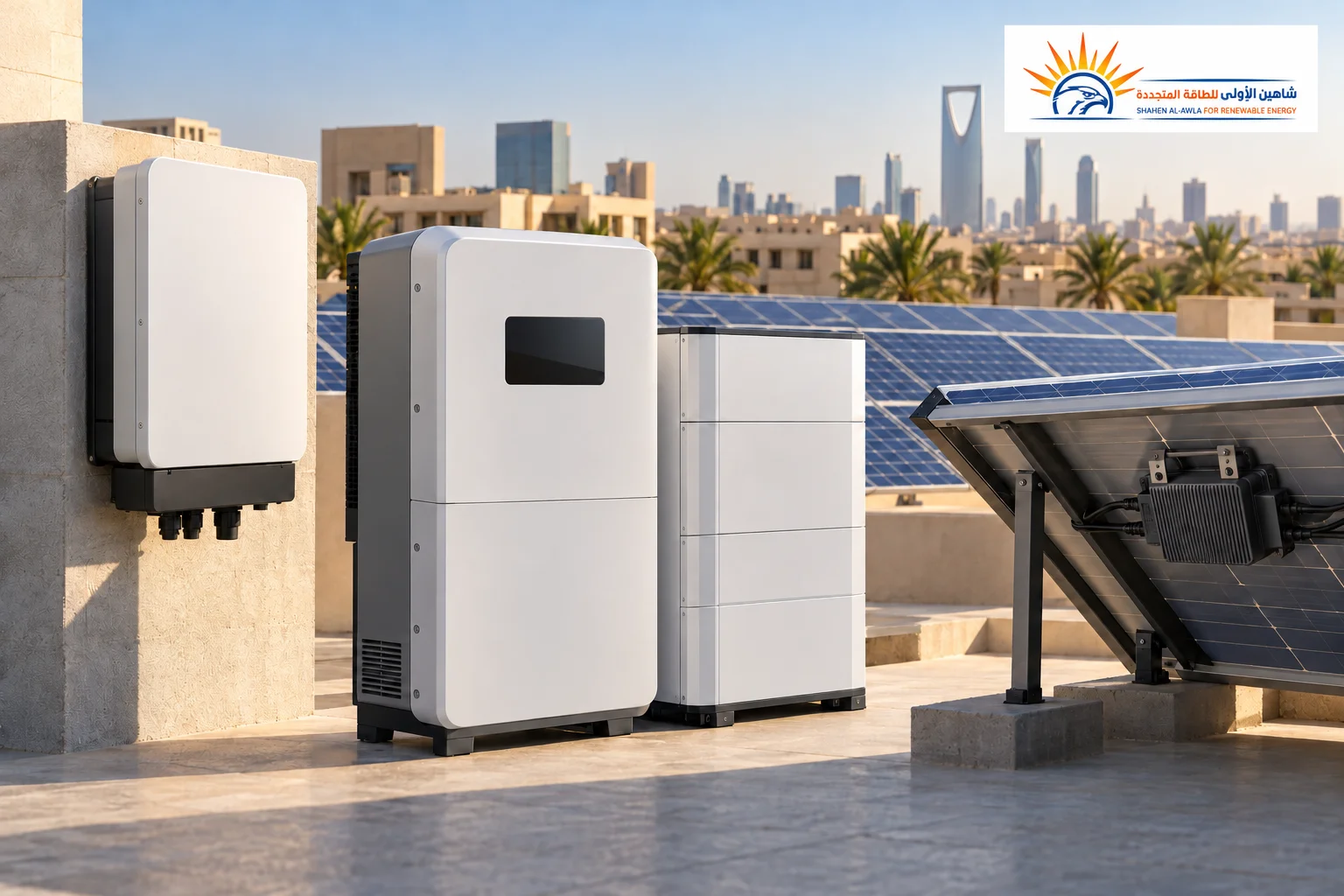
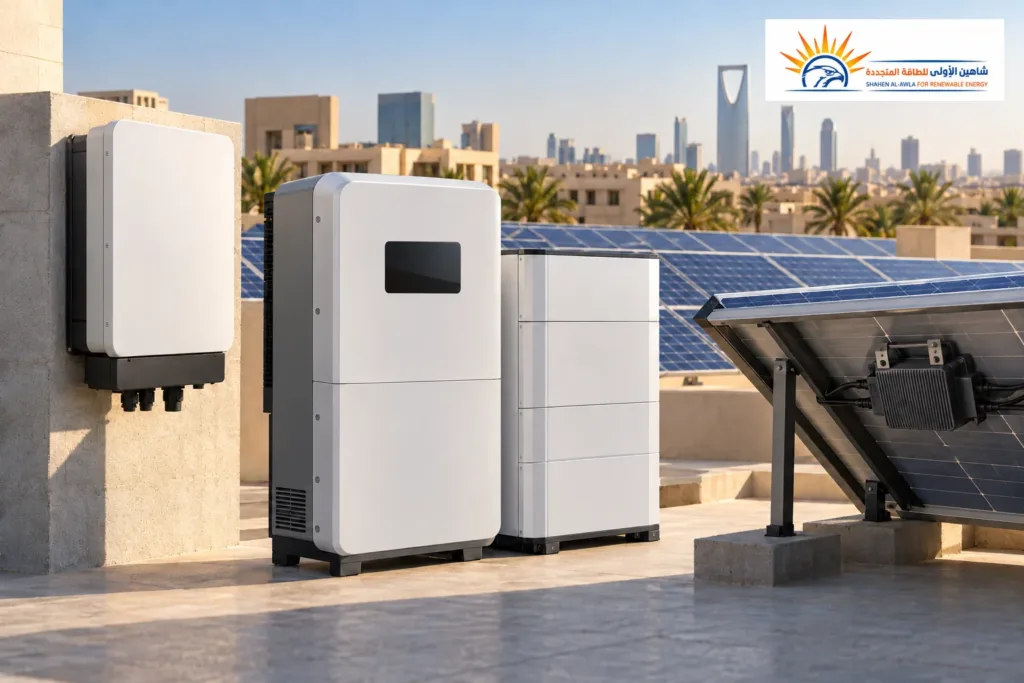
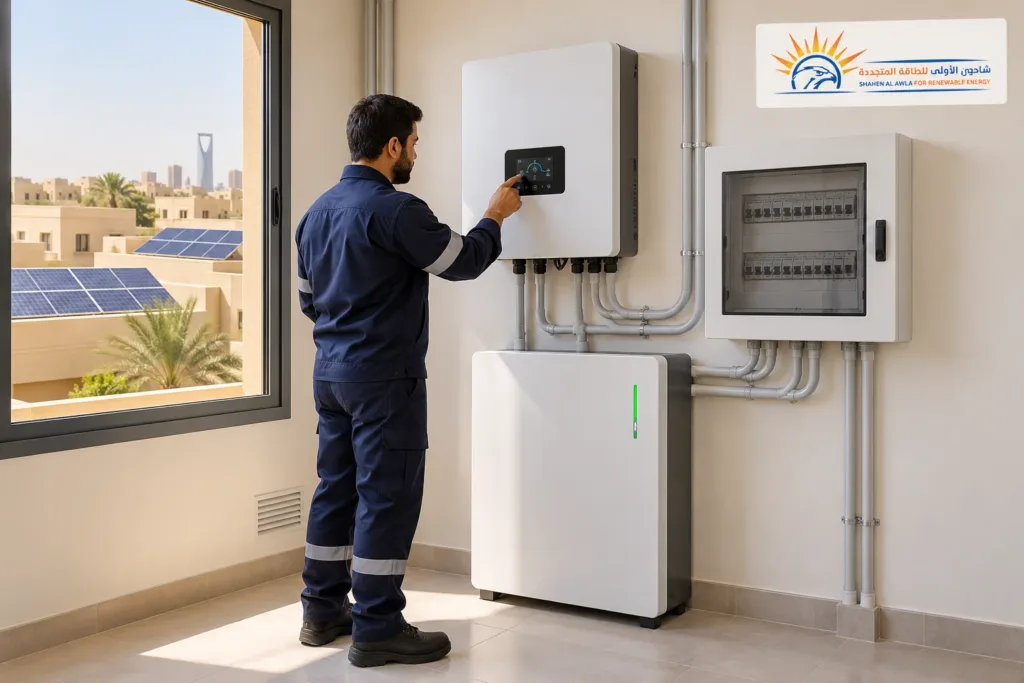
To understand the types of solar inverters, you first need to know what an inverter does. Panels produce direct current (DC), while most household and commercial appliances run on alternating current (AC). The inverter converts the electricity into a usable form, and may add functions for battery management, monitoring, and protection, depending on the model.
A higher inverter rating alone doesn’t mean a better system; it must match the panels’ voltage and current and the nature of the loads. You can refer to our guide to what solar panels are made of to understand the relationship between producing and converting electricity.
How Are Solar Inverters Classified?
The types of solar inverters can be grouped in more than one way. The first classification is by operating mode: on-grid, off-grid, or hybrid. The second relates to system architecture: string inverters, microinverters, or central inverters. There are also inverters designed specifically for pumps.
These classifications overlap; a string inverter can be on-grid or hybrid. So asking for a “solar inverter” without defining its function isn’t enough. Start by reviewing solar installation solutions in Saudi Arabia to define your project and its core components.
On-Grid Inverters
On-grid inverters are among the types of solar inverters suited to sites with public electricity, where the goal is to use panel production during the day to cover part of the consumption.
The inverter synchronizes with the grid’s voltage and frequency, and the grid covers demand when solar production drops. A conventional system usually doesn’t need batteries, which reduces the complexity and cost of storage. You can look at on-grid systems to understand the scope of the service and the consumption study needed before installation.
Does the System Keep Running During a Power Cut?
When comparing types of solar inverters, note that a conventional grid-tie inverter usually doesn’t provide backup power during a grid outage, even when the sun is shining; it stops feeding the grid for protection reasons and to prevent unintended islanding.
If you need to run the refrigerator, lighting, and communications equipment during outages, a suitable backup solution must be designed. Having panels doesn’t prove this capability by itself, and grid connection and export are subject to the relevant authority’s requirements and the project’s conditions.
Off-Grid Inverters
Off-grid inverters are among the types of solar inverters used at rest houses, remote sites, and facilities the grid doesn’t reach. They create an AC supply to power loads using the energy sources available in the design.
The system usually includes batteries to cover the night and periods of low production, and may support a backup source depending on the inverter. Off-grid systems need accurate calculation of daily energy and instantaneous power, because insufficient storage or poorly estimated loads can cause appliances to shut down earlier than expected.
Hybrid Inverters
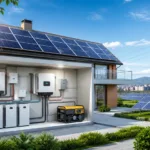
Hybrid inverters combine several functions, making them one of the most flexible types of solar inverters for managing panels, batteries, and the grid or other sources, according to the device’s design and settings.
But the word “hybrid” doesn’t guarantee every feature. Check whether there is a backup output, its capacity, the transfer time, and support for the specific batteries. Supporting the grid also doesn’t automatically mean exporting energy to it is allowed. For homes, our guide to home solar installation in Saudi Arabia helps link these options to how you use power and your roof space.
String Inverters
String inverters are among the types of solar inverters that receive energy from groups of panels connected electrically in series (strings). They suit many designs when the panels’ orientation and sun exposure are similar.
Check the number of maximum power point trackers (MPPT) and the voltage and current range for each input. Multiple trackers can help separate groups with different orientations or conditions, but they don’t solve every shading problem. String design remains essential to avoid exceeding the inverter’s limits or making poor use of the array.
Microinverters
Microinverters work at the level of a single panel or a small number of panels, depending on the product, and are among the types of solar inverters that give more independence in conversion and monitoring.
They may suit roofs with several orientations or where it’s hard to lay panels out uniformly. However, their cost, maintenance access requirements, and the heat conditions beneath the panels should be compared. They should also be distinguished from power optimizers; an optimizer doesn’t convert DC to AC on its own in systems that use a central inverter for conversion.
Central Inverters for Large Projects
Central inverters are among the types of solar inverters used in some high-capacity projects. They combine the output of many strings in larger conversion equipment, according to the plant’s engineering design.
Choosing them requires assessing load distribution, equipment location, protection, maintenance, and the impact of a unit going offline. They aren’t the automatic choice for every factory or warehouse; string inverters may be better in some cases. You can explore solar energy projects in Saudi Arabia to understand how needs differ between sectors.
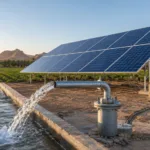
Inverters for Water Pumps and Submersible Pumps
Pump inverters differ from household inverters, even though they are included among the types of solar inverters. They manage the pump motor’s operation according to the available solar power, and may provide speed control and application-specific protection.
Before choosing one, define the motor’s power, voltage, and number of phases, as well as the required flow and head. In some applications, water can be stored in a tank instead of storing electricity in batteries. Learn about solar submersible pump systems to study a solution that fits your well and irrigation needs.
A Quick Comparison of Inverters
The table below helps compare the types of solar inverters by use; always refer to the model’s specifications before buying:
| Type | Typical use | Key things to check |
|---|---|---|
| On-grid | Using daytime production | Connection conditions, protection, and monitoring |
| Off-grid | Powering remote sites | Daily energy and battery capacity |
| Hybrid | Managing sources and storage | Compatibility and backup output |
| String inverter | Combining output from groups of panels | Voltage and current limits and MPPT |
| Microinverter | Panel-level conversion | Compatibility, cost, and maintenance |
| Central | Large projects | Design, reliability, and service |
| Pump inverter | Running submersible pumps and irrigation | Motor characteristics and pumping requirements |
How to Choose the Right Inverter Capacity
Comparing the types of solar inverters isn’t based on the number of panels alone. For backup and off-grid systems, start with the appliances that will run at the same time, their continuous power, and the starting currents of motors and compressors.
For on-grid systems, you need to balance array capacity with the inverter’s capacity, its limits, and the design strategy. Don’t confuse kilowatts, which measure power, with kilowatt-hours, which measure energy. For example, a 1 kW load running for five hours theoretically needs 5 kWh, before system losses and operating conditions are taken into account.
Panel and Battery Compatibility With the Inverter
A common mistake when choosing among the types of solar inverters is buying components separately and then trying to connect them without checking compatibility. Check the maximum panel voltage, the MPPT range, and current limits, taking into account how voltage changes with temperature.
For batteries, check the voltage, charge and discharge currents, and the communication protocol with the battery management system (BMS). Our guide to solar panel sizes also helps with space planning, and you can request Shahen’s solar component supply within a compatible design.
Heat and Dust Considerations in Saudi Arabia
Comparing types of solar inverters in Saudi Arabia means reviewing the power derating curve with temperature, the operating limits, and the protection rating suited to the installation location. A device may work efficiently in certain conditions, then lose available power as the temperature rises.
Choose a shaded, well-ventilated location according to the manufacturer’s instructions, with service clearances and away from heat sources. In coastal areas, check the equipment’s suitability for the surrounding environment. An outdoor protection rating doesn’t mean the device can be installed anywhere without a study.
Inverter Cost and How to Compare Quotations
Prices for the types of solar inverters vary with capacity, functions, warranty, protection, monitoring, and after-sales service. So compare equivalent offers, and don’t settle for the price of the device on its own.
Ask for a breakdown that specifies the model number, included components, installation work, protection, monitoring settings, warranty, and exclusions. Our article on the cost of home solar installation helps you understand the budget items. You can check the Shahen store for products and prices at the time of ordering, without assuming a permanent discount.
Practical Steps Before Buying
To compare the types of solar inverters in an organized way, prepare your electricity bill or a load table, and define your hours of use and the appliances that need backup power. Then follow these steps:
- Decide which type of system suits your goal.
- Review roof space, shading, and cable routes.
- Ask for the required power and energy to be calculated.
- Check that the panels and batteries are compatible.
- Compare warranty, service, and total cost.
- Ask for a clear diagram and a written scope of work.
Shahen’s design and consulting service lets you study the components before committing to a purchase.
Maintenance and Monitoring After Commissioning
Whatever the types of solar inverters, monitoring operation helps catch faults early. Track energy produced, error messages, and the connection to the monitoring platform, and compare performance under similar conditions rather than judging from a single reading.
A professional inspection covers connections, protection, earthing, ventilation, and battery condition where there is one. Don’t open the device or change its electrical settings without a specialist. Shahen’s maintenance and technical support can assess drops in performance and address the cause instead of replacing components at random.
Choose the Inverter Based on Your Project’s Needs
Choosing correctly among the types of solar inverters starts with understanding your consumption and your site, then deciding on the operating mode and checking component compatibility. A home, a farm, and a warehouse don’t necessarily need the same solution, and adding capacity without calculation doesn’t guarantee better performance.
Gather your load data, define your operating priorities and budget, then ask for a quotation that sets out the inverter, panels, storage, protection, and installation services. You can request a site survey and quotation to get a proposal that fits your project in Saudi Arabia before buying equipment.
Frequently Asked Questions
What is the best solar inverter for a home?
There is no absolute best among the types of solar inverters; the choice depends on whether the home is grid-connected and whether it needs storage and backup power. An on-grid system may be enough to cover daytime consumption, while backup loads need different equipment.
Can an inverter run without batteries?
Yes. Conventional grid-tie inverters usually run without batteries, and other devices support direct operation from the panels under certain conditions. But keeping power on at night or when production is low needs another source, and the word “hybrid” alone doesn’t settle that.