
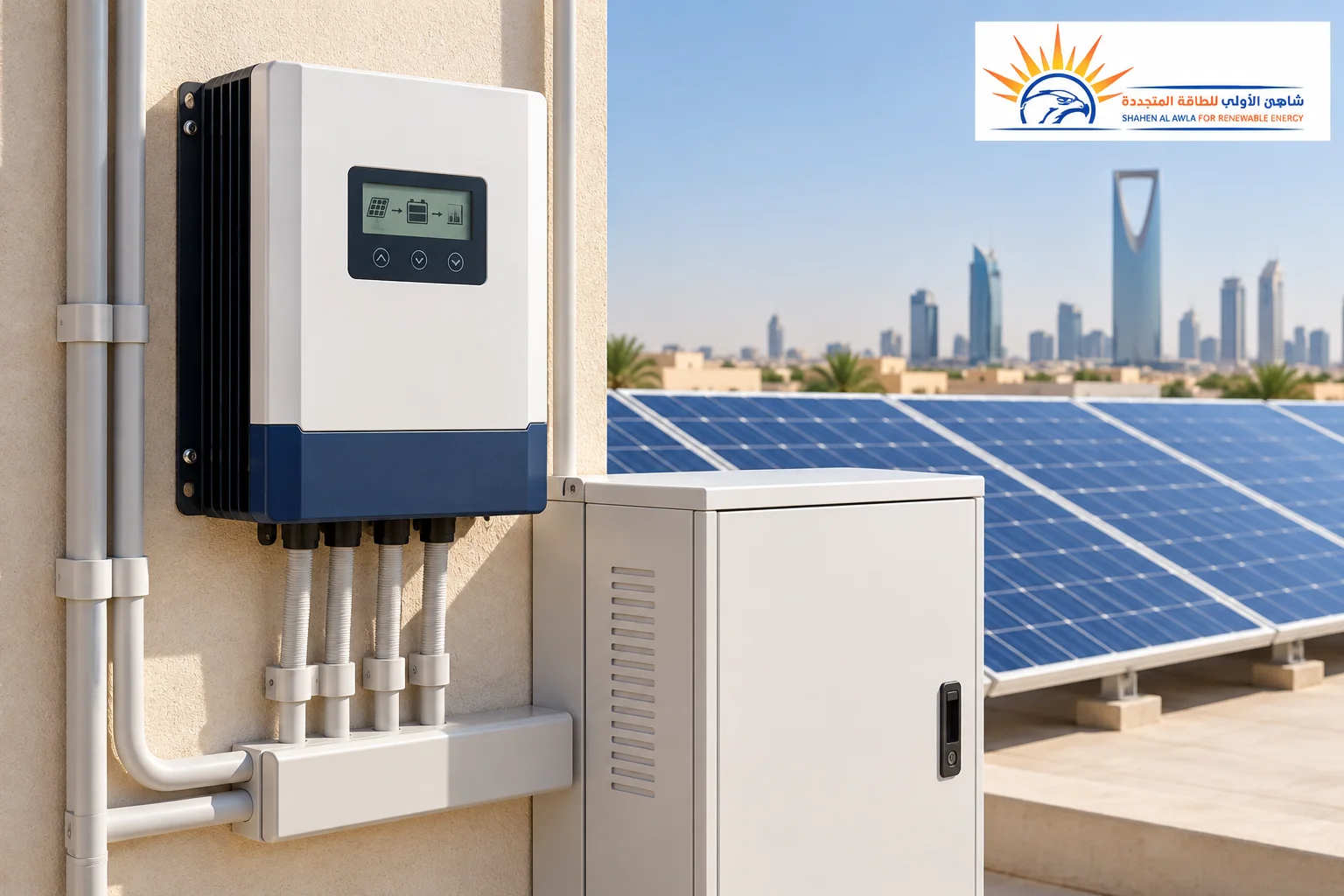
Choosing the right solar charge controller is an important step in building a battery-based system, and Shahen helps you study your project’s needs and choose compatible components instead of buying equipment on price alone. The controller manages how the battery is charged with energy from the panels, and it works within a system that may include an inverter, batteries, and electrical protection. The needs of a small home differ from those of a remote rest house or a farm, so consumption, operating hours, and battery type should be defined before choosing a device. In the Saudi market, heat, site conditions, and the availability of technical support are part of the comparison, along with voltage, current, and room for future expansion.
What Is a Solar Charge Controller and What Does It Do?
A solar charge controller manages the flow of energy from the panels to the battery within the battery’s appropriate charging limits. It adjusts voltage and current according to the battery’s state and the device settings, which helps avoid unsuitable charging and makes better use of the available energy. It may include an output for small loads with a low-voltage disconnect function, but this varies between models.
To understand where the electricity comes from before the charging stage, you can read our guide to what solar panels are made of. The panel produces electricity, and the charge controller manages how it is used to fill the battery within a specific design.
Do All Solar Systems Need a Separate Controller?
Not every system requires buying a separate solar charge controller. Conventional grid-tied systems without batteries usually rely on a grid-tie inverter and don’t need a separate battery charge controller. Some hybrid inverters also have a built-in solar charger, which may make an extra device unnecessary if its specifications are suitable.
Standalone systems built from separate components may need a dedicated controller between the panels and the batteries. You can review on-grid systems and off-grid systems to understand the difference before buying equipment.
The Difference Between a Charge Controller and an Inverter
When buying a solar charge controller, it’s important to distinguish it from an inverter. The controller manages battery charging from the panels, while the inverter converts direct current into the alternating current that some appliances need. One device may combine both functions, but that doesn’t make them the same thing.
Also, an inverter’s power in watts can’t be compared with a controller’s current in amps without understanding how they relate. Each component has different operating limits, and the parts should be chosen as one system. Our guide to solar installation in Saudi Arabia helps you understand the design, supply, and installation stages.
PWM Charge Controllers: When Are They Suitable?
A PWM solar charge controller uses pulse-width modulation to control charging, keeping the panels’ operating voltage close to the battery voltage while charging. It therefore needs a suitable match between the panels’ nominal voltage and the battery system, within the manufacturer’s limits.
It can be an economical option for some small, simple systems, especially when the components match its requirements. But it doesn’t make use of the panels’ voltage difference the way MPPT technology does. It shouldn’t be dismissed as always unsuitable; the choice depends on system size, cost, and operating conditions.
MPPT Charge Controllers: How Do They Work?
An MPPT solar charge controller tracks the panels’ maximum power point, then converts the energy into a voltage and current suitable for charging the battery. This allows panel arrangements with a higher voltage than the battery, within the model’s permitted limits, taking into account its tracking range and start-up voltage.
This flexibility is useful in many designs, but it doesn’t justify exceeding the maximum input voltage or current. The extra energy gained compared with PWM isn’t a fixed percentage either; it is affected by temperature, battery voltage, panel characteristics, irradiance, and the quality of the design.
MPPT vs PWM
Before deciding on the best solar charge controller for your project, compare the two technologies against your system’s actual needs:
| Criterion | PWM | MPPT |
|---|---|---|
| How it works | Controls charging by modulating pulses | Tracks the maximum power point and converts voltage |
| Panel voltage compatibility | Needs a suitable match with battery voltage | Offers more flexibility within the device’s specifications |
| Upfront cost | Usually lower for basic models | Usually higher when comparing devices of similar quality |
| Typical use | Small, matched systems | Systems that need flexibility and more output from the array |
| What decides the choice | System needs and cost | Operating limits, expected gain, and compatibility |
The technology name alone isn’t enough to judge quality; protection features, settings, warranty, and documented specifications are also essential.
How to Choose the Right Controller Current
Choosing a solar charge controller depends on both the panel input limits and the charging output. In MPPT devices, output current is linked to panel power and battery charging voltage, while the maximum input current and permitted short-circuit current of the array must be checked separately.
Purely as an illustration, 1,000 watts divided by a charging voltage of around 28 volts gives about 36 amps in theory, before operating conditions and device limits are taken into account. This calculation is not a final design and isn’t enough to choose a model. Ask for Shahen’s design and consulting service to calculate the right capacity and the margins needed.
Why the Number of Panels Isn’t Enough
A solar charge controller may handle a certain number of panels in one arrangement but not the same number in another. Connecting panels in series raises the voltage, and connecting them in parallel raises the current, so the result differs even if the total power stays similar.
The panels’ open-circuit voltage should be calculated at the lowest expected temperature, and the operating range should also be checked in hot conditions. You must make sure the input limits aren’t exceeded. Our guide to solar panel sizes helps with space planning, but it doesn’t replace the electrical calculation.
Compatibility With Lithium and Lead-Acid Batteries
A solar charge controller must be set up according to the battery’s chemistry and its manufacturer’s instructions. Lead-acid and lithium batteries differ in charging voltages and suitable settings, and a generic charging mode shouldn’t be chosen without checking compatibility.
For lithium batteries, check the current and voltage limits, the requirements of the battery management system (BMS), and any communication needed between components. Equalization settings used for some lead-acid batteries should not be enabled automatically with lithium. You can use Shahen’s solar component supply service to choose parts that are compatible with the design.
The Effect of Heat in Saudi Arabia
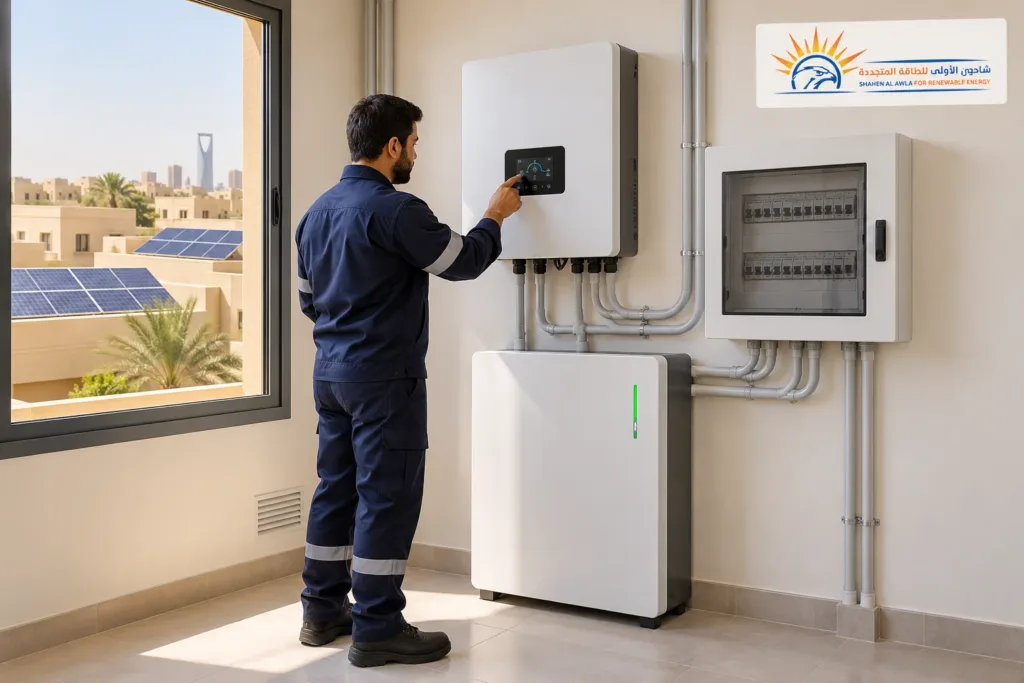
Operating a solar charge controller in Saudi Arabia requires checking its operating temperature and current or power derating curve, as well as the installation location. A device may tolerate a certain temperature but not deliver its full rated current in all conditions.
Install the controller in a suitable, well-ventilated location according to the manufacturer’s manual, away from direct sun and heat sources, with service clearances. Check whether a battery temperature sensor is needed, depending on the battery type. Don’t use temperature compensation designed for lead-acid with other batteries unless their instructions allow it.
Applications for Homes, Rest Houses, and Farms
A solar charge controller can be part of a lighting system for a rest house, a standalone system powering specific appliances, or an agricultural project that needs electricity storage. Its role is defined by how the system operates and whether there are batteries, not by whether the site is called a farm or a home.
Solar pumps may use dedicated motor inverters without batteries, so they don’t necessarily need a conventional charge controller. See submersible pump systems for agricultural applications, and our guide to home solar installation for residential uses.
Can Appliances Run From the Load Output?
Having a load output on a solar charge controller doesn’t mean it’s suitable for connecting every appliance. It may be designed for limited DC loads, with a maximum current separate from the charging current. So don’t connect an air conditioner, pump, or large inverter to it without explicit approval in the device’s manual.
Large loads need suitable circuits, protection, and connections designed by a specialist. And don’t assume the load output provides a regulated voltage suitable for every device; check the actual voltage and the load’s requirements before connecting.
How to Compare Price and Warranty
The price of a solar charge controller varies with the technology, current, maximum panel voltage, programming and monitoring features, protection, and warranty. Two devices labeled with the same current can be completely different in their ability to serve your project.
Ask for the model number, datasheet, warranty terms, and what the supply and installation offer includes. You can review the cost of home solar installation to understand the full budget. When browsing the Shahen store, check the model’s availability and actual price rather than assuming there’s a permanent offer or discount.
Common Mistakes When Buying
The most common mistakes when choosing a solar charge controller are focusing on amps alone, ignoring the maximum panel voltage, or assuming all MPPT devices are equal. Other mistakes include:
- Buying the device before deciding on the battery type.
- Confusing panel input current with charging output current.
- Connecting extra panels without recalculating.
- Ignoring heat and ventilation.
- Using unsuitable charging settings.
- Relying on the display alone as proof of accurate measurement.
So compare technical specifications first, then price, and make sure support is available to help with setup or when faults appear.
Installation and Electrical Protection
Installing a solar charge controller requires cables, protection, and disconnects suited to the voltage, current, and cable run length. There is no single breaker rating or cable size that suits every controller; these are determined by the design and the equipment manual.
Follow the connection and disconnection sequence specified by the manufacturer, and don’t assume steps shared online apply to every device. The battery circuit must be protected, and earthing and ventilation requirements must be observed. You can review Shahen’s services to define the survey, supply, and installation scope your site needs.
Monitoring and Maintenance After Commissioning
Monitor the performance of your solar charge controller through charging status, recorded energy, fault messages, and available temperature readings, comparing readings under similar conditions. A lower charging current doesn’t always mean a fault; the battery may be full, irradiance may be low, or the device may be limiting current because of heat.
Find the cause before changing settings or replacing components. Shahen’s maintenance and technical support can review connections, protection, and battery condition, and diagnose unusual drops in performance.
Checklist Before Approving a Quotation
Before buying a solar charge controller, prepare the following information to make comparison easier and get an accurate quotation:
- Battery type, voltage, capacity, and charging limits.
- Each panel’s power, open-circuit voltage, and short-circuit current.
- The number of panels and how they’re connected.
- The temperature at the installation site.
- The charging current required and room for expansion.
- Whether you need a display or remote monitoring.
- Warranty scope and setup and maintenance service.
Solar energy projects in Saudi Arabia show why components and design approaches differ between sectors.
Choose Compatible Components From the Start
The best solar charge controller for your project is the one that matches your panels, battery, and site conditions, and offers the functions you actually need with clear warranty and support. Start by calculating consumption, then decide on the operating and storage method, and ask for a design that explains the role of each component before buying.
With Shahen, make a study of your needs and specifications the basis of your comparison, and ask for a written quotation that sets out the components, protection, installation, and follow-up, so you build a system that suits your home, rest house, or farm in Saudi Arabia.
Frequently Asked Questions
Which is better: MPPT or PWM?
An MPPT solar charge controller may be the better choice when you need more flexibility in panel voltage and want to make full use of the panels’ power, while PWM may suit some small, matched systems. The final decision depends on the design, cost, and operating conditions.
Do I need a separate controller with a hybrid inverter?
Not always; the inverter may have a built-in solar charger. Check its specifications, voltage and current limits, and battery compatibility before adding a separate device, because unnecessary components can raise the cost and complicate setup.