The components of a solar submersible pump system are the foundation on which the success of any renewable-powered water pumping project depends, whether on farms, at wells, in agricultural projects, or in remote areas. Shahen Al-Awla provides specialized solar energy solutions and can design a system that matches the pump’s power, the depth of the well, and the amount of water required, helping to achieve stable operation and lower energy costs.
What Is a Solar Submersible Pump System?
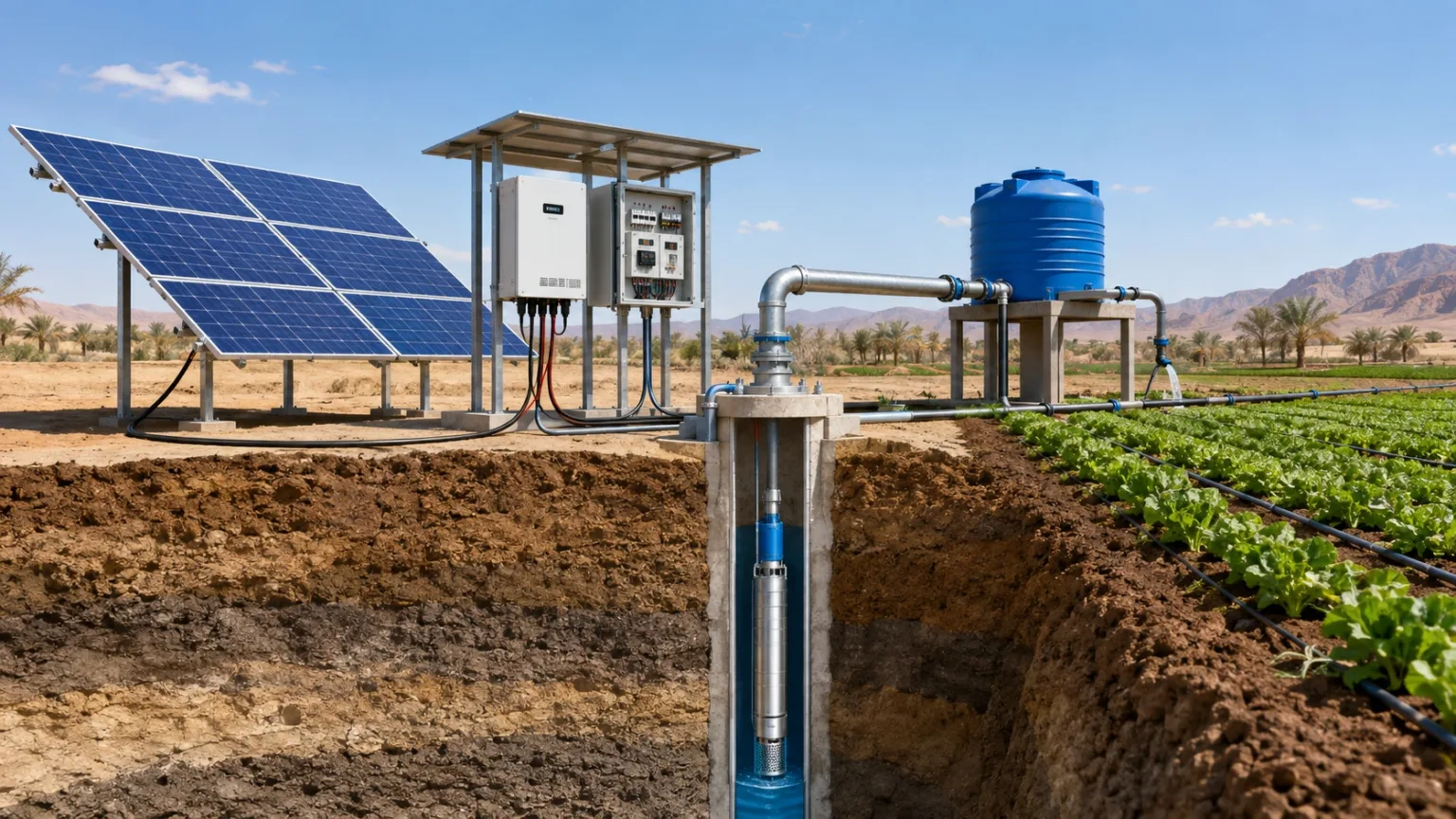
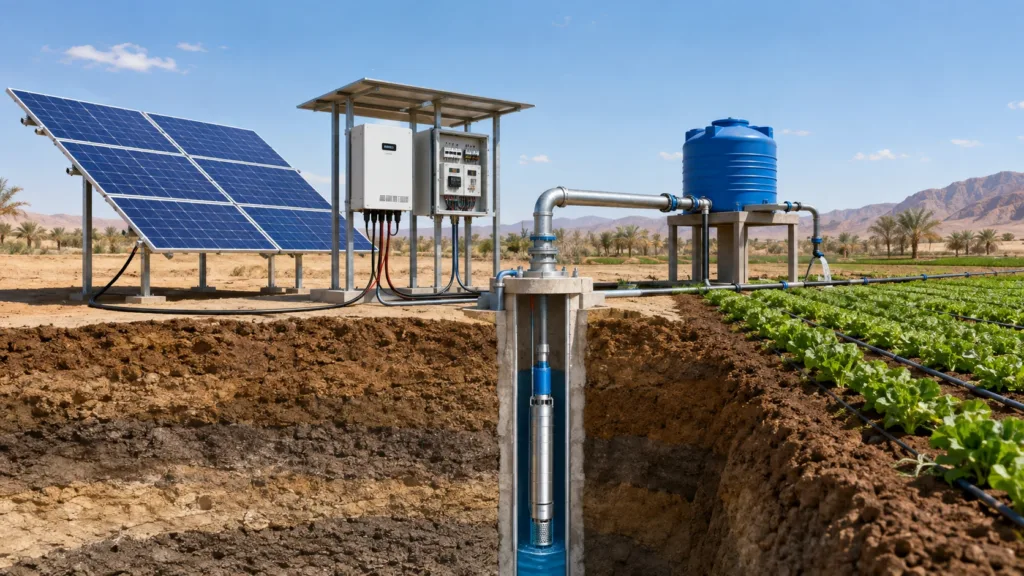
A solar water pumping system converts sunlight into electrical energy that is used to run a submersible pump. The system is made up of several parts that work together, starting with the solar panels that produce electricity, then the controller or inverter, and finally the pump motor that moves the water.
The system’s success doesn’t depend on choosing just one component, but on all components being compatible in power, voltage, current, and type of use.
System specifications vary according to:
- The power of the pump motor.
- The depth of the well.
- The water level.
- The amount of water needed each day.
- The flow rate.
- The height the water needs to be pumped to.
- The pump’s operating hours.
- Solar irradiance at the site.
- The type of irrigation or water distribution network.
That’s why a technical study should be carried out before buying equipment or starting installation.
The Main Components of a Solar Submersible Pump System
The components of a solar submersible pump system include a set of main elements whose capacity and specifications vary from project to project. The most important are the solar panels, the inverter, the pump, cables, and protection systems, plus a tank and water distribution network where needed.
Below is an explanation of the main parts of the system and what each one does.
Solar Panels
Solar panels are the system’s main energy source, converting sunlight into electrical energy that can be used to run the pump.
The panels are installed in a suitable location that exposes them to as much sunlight as possible, avoiding shading from buildings, trees, or other obstacles.
Read more:
Solar panel prices in Saudi Arabia
Solar batteries in Saudi Arabia
Hybrid solar energy projects
How are solar panels chosen?
The number of panels isn’t decided at random, but based on a set of technical calculations, including:
- The pump’s power.
- The required operating hours.
- The energy the pump needs.
- The number of effective sun hours.
- Inverter efficiency.
- Cable losses.
- Weather conditions and temperatures.
- The space available for the panels.
It’s important that the panels are compatible with the inverter used, in voltage, current, and total capacity.
The Solar Inverter
The inverter is one of the most important components of a solar submersible pump system, because it regulates the power coming from the panels and converts it into the right form to run the pump motor.
Some inverters are designed specifically for solar water pumping applications and can control the pump’s speed according to the power available from the panels.
The inverter’s main functions include:
- Converting the electrical current when needed.
- Regulating voltage and frequency.
- Controlling pump operation.
- Making better use of solar energy.
- Providing some protection functions.
- Regulating motor speed in systems that support it.
The inverter should be chosen according to the power and type of the pump motor, not on price alone.
The Submersible Pump
The submersible pump is the part responsible for drawing water from the well or source and pushing it to where it’s needed.
Choosing the pump is one of the most important stages of system design, because its power must match the water depth, flow rate, pressure, and required lift.
A pump that suits a small farm may not suit a deep well that needs higher pressure or a greater pumping rate.
Factors that affect pump choice
Before buying a pump, you need to know:
- The depth of the well.
- The water level during operation.
- The well diameter.
- The amount of water required.
- The flow rate.
- The height of the water delivery point.
- The length of the water delivery line.
- The type of irrigation network.
- The number of daily operating hours.
All this data helps determine the right pump power.
The Pump Controller
Some systems use a dedicated pump controller, which may be built into the inverter or separate from it, depending on the system design.
The controller helps manage operation and monitor pump performance, and it may include functions that protect against unsuitable operating conditions.
Functions that may be available in controllers include:
- Dry-run protection.
- Overcurrent protection.
- Under- and overvoltage protection.
- Pump operation control.
- Monitoring some performance data.
- Shutting the system down when a problem occurs.
The available functions vary by controller type and manufacturer.
Cables and Electrical Wiring
Cables are an important part of the system because they carry power between the panels, the inverter, and the pump.
Cables should be chosen according to voltage, current, distance, and installation conditions.
It’s not advisable to use cables below the required specification to cut costs, because this can increase electrical losses, raise cable temperature, or affect system efficiency.
Cables should also be protected from environmental factors, especially when the system is installed in exposed locations or near water.
Electrical Protection Devices
The components of a solar submersible pump system also include a set of protection elements that help protect equipment from electrical problems.
The protection system may include:
- Suitable circuit breakers.
- Overcurrent protection.
- Over- and undervoltage protection.
- Protection against overcurrent caused by certain faults.
- Earthing systems.
- Surge protection, depending on the system design.
- Protection enclosures suited to the site.
These components help reduce the risk of faults and protect equipment, but they must be selected according to the system’s electrical design.
The Water Storage Tank
A tank isn’t necessary in every pumping system, but it can be an important part of the setup in many applications.
Instead of storing electricity in large batteries, some projects run the pump while the sun is available and store the water in a tank for later use.
The main benefits of a tank include:
- Providing water when there is no sun.
- Reducing the need for batteries in some applications.
- More stable irrigation.
- Having a supply of water ready for use.
- Helping to organize water distribution.
The size of the tank depends on daily consumption and the nature of the project.
Are Batteries Necessary?
One of the key questions when studying the components of a solar submersible pump system is whether the system needs batteries.
The answer isn’t the same for every project.
If the goal is to run the pump during daylight hours and pump water into a tank, batteries may not be necessary. If the project needs to run the pump after sunset or during long periods without solar energy, batteries may be used according to the design.
The cost, lifespan, and maintenance needs of batteries should be compared with the option of storing water in a tank before deciding.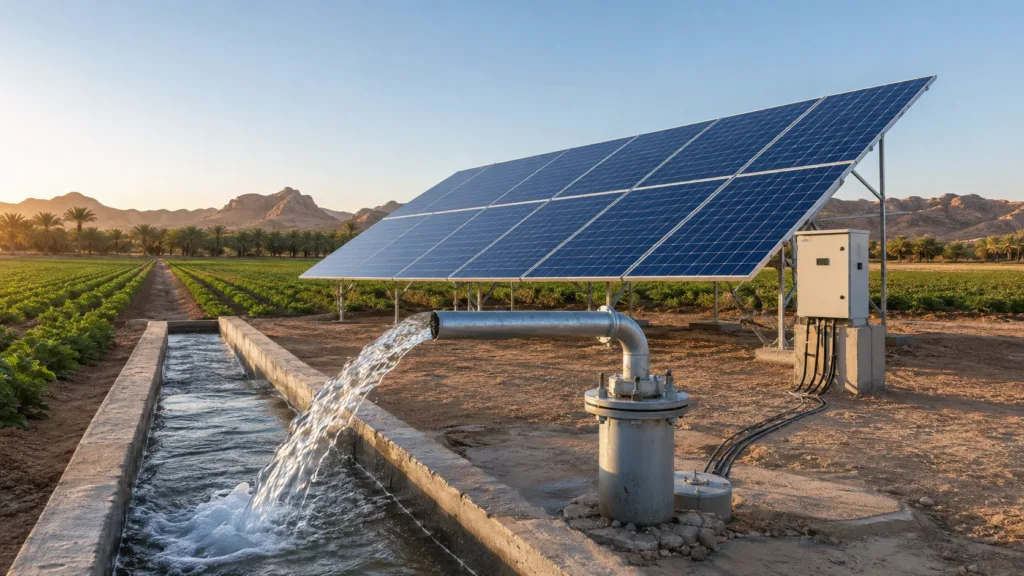
The Water Transmission and Distribution Network
After water is pumped from the well, it needs to reach where it will be used. The system may therefore include a network of pipes, valves, filters, and other elements depending on the project.
The water network directly affects pump performance, because long pipe runs, large elevation changes, or high flow resistance can affect pressure and how much water arrives.
So the pump should not be chosen without studying the entire water network.
Sensors and Measuring Systems
Advanced pumping systems may include sensors that help monitor water level, pressure, flow, and pump condition.
Examples of sensors used include:
- Water level sensor.
- Pressure sensor.
- Flow sensor.
- Dry-run protection sensor.
These sensors improve system control and reduce the chance of the pump running in unsuitable conditions.
How Do You Choose the Right System Components?
Choosing the components of a solar submersible pump system depends on studying the project’s needs before deciding on the final components.
It’s best to follow these steps:
Identify the water source
Find out whether the source is a well, a tank, or something else, and determine the water depth and level during pumping.
Determine the amount of water required
Calculate the expected daily consumption, because the amount of water needed affects the size of the pump and the solar capacity required.
Determine the flow rate
Determine how much water must be pumped in a given time, such as liters per minute or cubic meters per hour.
Determine the head
Calculate the vertical distance the water must travel, plus the resistance of the pipe network.
Choose the pump
Once you have this data, you can choose the right pump in terms of power, flow, and head.
Determine the solar capacity
Calculate the energy needed to run the pump, then determine the number of panels and the wattage of each.
Choose the inverter
Choose an inverter compatible with the pump motor’s type, power, and required voltage range.
Choose the protection devices
Specify breakers, cables, protection, and earthing in line with the electrical design.
Calculating the Panel Capacity a Pump Needs
Panel capacity can’t be determined just from the motor’s power, because the energy needed for operation is affected by several factors.
If the pump needs to run for several hours a day, calculate the total daily energy required, then compare it with the energy the panels can produce at the site.
Keep in mind that panel output isn’t constant throughout the day, so use solar irradiance data and add a suitable margin for losses.
It’s best to have these calculations done by a solar energy specialist to make sure the design is accurate.
Key Advantages of a Solar Pump System
When the components of a solar submersible pump system are chosen and designed correctly, they can provide a practical and sustainable solution for pumping water.
The main advantages include:
Lower electricity consumption
Relying on the sun helps reduce the need for conventional electricity during operating hours.
Lower fuel costs
In projects that use fuel generators, a solar system can help reduce reliance on them.
Suitable for remote areas
The system can be used at sites without a suitable grid connection.
Relying on a renewable energy source
Solar energy is renewable and can be used for long periods with proper maintenance.
Low maintenance for the panels
Panels have no moving mechanical parts, but they need regular cleaning and inspection.
Mistakes to Avoid When Designing the System
Several mistakes can affect system efficiency, including choosing components before studying water needs.
The most common mistakes include:
- Choosing a pump larger than needed.
- Choosing a pump smaller than required.
- Not calculating the well depth correctly.
- Ignoring the height of the delivery point.
- Using too few panels.
- Choosing an inverter that isn’t compatible with the motor.
- Using unsuitable cables.
- Neglecting protection devices.
- Installing panels in a shaded location.
- Not cleaning the panels regularly.
- Ignoring the quality of the pipe network.
A balanced design makes better use of the investment in the system.
Maintaining Solar Pump System Components
Regular maintenance helps keep the system efficient and reduces the likelihood of faults.
The most important maintenance tasks include:
- Cleaning the solar panels regularly.
- Inspecting connections and cables.
- Monitoring inverter performance.
- Tracking the water pumping rate.
- Inspecting the pump according to the manufacturer’s instructions.
- Making sure electrical protection is working.
- Inspecting the tank and pipes.
- Checking for leaks.
- Monitoring the water level in the well.
If the pumping rate drops noticeably, the entire system should be checked rather than replacing the pump straight away.
How Do You Know the System Is Working Efficiently?
You can track several indicators to understand system performance, such as the water flow rate, the energy produced by the panels, operating hours, and the inverter’s status.
Signs that call for an inspection include:
- A drop in the amount of water.
- The pump stopping frequently.
- Errors appearing on the inverter.
- An abnormal rise in the temperature of some components.
- Lower solar production than under normal conditions.
- Unexplained changes in water pressure.
Continuous monitoring helps detect problems at an early stage.
Shahen Al-Awla’s Role in Solar Energy Systems
When carrying out a solar-powered project, it isn’t enough to just buy and install the components; you need to make sure every part of the system is compatible with the others.
Projects need a study covering water needs, pump power, the nature of the water source, the required solar capacity, and how water will be distributed.
Shahen Al-Awla provides solutions that can be designed around each project’s requirements, with attention to choosing suitable components and an installation method that helps achieve efficient operation.
Cost of Solar Submersible Pump System Components
System costs vary from project to project, and no fixed price can be set for every application.
Cost is affected by several factors, the most important being:
- Pump power.
- Number of solar panels.
- Inverter capacity and type.
- Cable length.
- Well depth.
- Tank size.
- The pipe network.
- Protection devices.
- Installation costs.
- The nature of the site.
It’s best to get a technical study that defines the project’s needs before comparing prices.
Is Investing in a Solar System Worth It?
Investing in the components of a solar submersible pump system can make sense when a project needs to pump water regularly, especially on farms and at sites where electricity or fuel costs are high.
When evaluating the investment, compare the upfront cost with the electricity or fuel costs that will be saved over the long term, as well as possible maintenance and replacement costs.
Choosing good-quality components and designing the system correctly can also have a big impact on how long the project delivers value.
The efficiency of solar water pumping systems depends on all the components of a solar submersible pump system working together, from the solar panels and inverter to the pump, cables, protection, tank, and water network.
There is no single system that suits every project, because each one needs a design based on well depth, the amount of water required, flow rate, pumping head, operating hours, and site conditions.
The best step before buying equipment is therefore a complete technical study, followed by choosing components based on the required capacity and their compatibility, not on price alone. With good design, correct installation, and regular maintenance, solar water pumping systems can offer a practical and effective way to reduce water pumping costs and make use of a renewable energy source.