An on-grid solar system for farms has become an important solution for agricultural projects that have access to the electricity grid and use large amounts of power during the day. Shahen provides complete solutions that start with studying the farm’s loads and electricity consumption and surveying the site, then designing the system and choosing suitable panels, inverters, and protection, through to supply, installation, commissioning, follow-up, and maintenance.
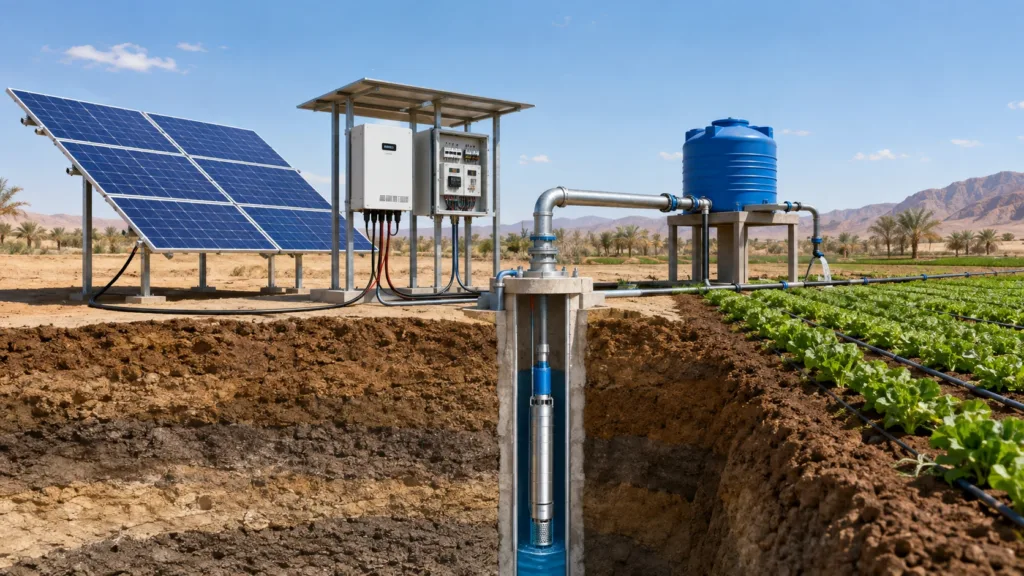
Solar power is increasingly important on farms because many loads run during the day, such as water pumps, submersible pumps, irrigation systems, ventilation, cooling, lighting, and various agricultural equipment. When these loads run at the same time as the panels produce power, solar energy can reduce the amount of electricity drawn from the grid.
What Is an On-Grid Solar System for Farms?
It’s a system that produces electricity from solar panels and uses it alongside the public grid. During sunshine hours, the energy produced covers part of the farm’s consumption, while the grid supplies the extra electricity when panel production is lower than the required loads.
Unlike an off-grid system, a grid-tied system usually doesn’t need storage batteries, because the grid remains available to cover consumption when solar production isn’t enough.
You can look at Shahen’s solar energy services to see the types of systems available for farms and facilities.
How Does an On-Grid System Work on a Farm?
The idea behind an on-grid solar system for farms is to use the panels’ production at the same time as agricultural loads are running.
In simple terms, the process works like this:
- The panels receive sunlight and produce direct current (DC).
- The electricity goes to the solar inverter.
- The inverter converts it into alternating current (AC) suitable for the loads.
- The farm uses the solar energy to run part of its equipment and appliances.
- If consumption exceeds the available production, the difference is drawn from the grid.
- When panel production drops in the evening or at night, the grid continues to supply the farm.
That’s why the system is most effective when a large share of the loads coincides with daylight hours.
Why Does an On-Grid Solar System Suit Agricultural Projects?
Many agricultural activities have high electricity consumption during the day, the same period when solar panels produce the most energy.
Benefits can include:
- Reducing grid electricity consumption during the day.
- Making use of open land or the roofs of farm buildings.
- Usually no need for batteries in a conventional grid-tied system.
- The ability to design the system around the farm’s actual loads.
- The ability to monitor the energy produced.
- Reducing part of the operating costs over the long term.
- The option to study expansion if the farm’s loads grow in future.
What Types of Farms Can Benefit From the System?
An on-grid solar system for farms can be studied for various types of agricultural projects that have a grid connection, including:
- Vegetable and crop farms.
- Fruit and date palm farms.
- Greenhouses.
- Poultry farms.
- Livestock projects.
- Farms with automated irrigation systems.
- Farms with cold storage.
- Agricultural projects with large water pumps.
That doesn’t mean the design will be the same for all these projects; each farm needs its own study of loads and operating patterns.
How Is the Right System Capacity for a Farm Determined?
Designing an on-grid solar system for farms starts with analyzing actual consumption, not just choosing a number of panels.
It’s best to prepare the following data before requesting a study:
- Electricity bills for several months.
- Average monthly consumption.
- The farm’s operating hours.
- The capacity of pumps and submersible pumps.
- Daily irrigation hours.
- The capacity of cooling and ventilation systems.
- Other loads at the site.
- Seasonal changes in consumption.
- The space available for panels.
- Any expected future expansion.
The Importance of Daytime Loads on the Farm
An on-grid solar system for farms delivers more benefit when a large part of electricity consumption falls during the panels’ production period.
For example, if pumps, irrigation, and cooling systems run between morning and late afternoon, part of their consumption can coincide with solar production.
If most of the farm’s consumption happens at night, the project needs to be studied differently to find the most suitable system, because a conventional grid-tied system doesn’t store electricity in batteries by default.
So knowing monthly consumption alone isn’t enough; it’s also useful to know when consumption happens.
The Main Components of a Farm Solar System
The energy system consists of several elements that must work together efficiently, and the success of an on-grid solar system for farms doesn’t depend on the panels alone.
Solar Panels
Panels produce electricity from solar radiation, and they differ in:
- Power.
- Efficiency.
- Technology used.
- Dimensions.
- Warranty.
- Degradation rate.
- Suitability for the available space.
You can read our guide to solar panel prices in Saudi Arabia to learn about the factors that affect the cost of panels and systems.
Choosing Panels for an On-Grid Farm System
Agricultural projects may have large areas available for panels, but that doesn’t mean using as many as possible is the best choice.
The required capacity should be defined first, then panels chosen to suit:
- The electrical load.
- The space.
- The mounting orientation.
- Shaded areas.
- Inverter capacity.
- Future expansion.
Suitable paths and walkways should also be provided for reaching the panels for cleaning and maintenance.
The Solar Inverter
The inverter is one of the most important components of an on-grid solar system for farms, converting the current from the panels into electricity suitable for use on the farm.
The inverter is chosen according to factors including:
- System capacity.
- Number of panels.
- Panel string layout.
- Voltage.
- Grid characteristics.
- Number of MPPT inputs.
- Inverter efficiency.
- Available monitoring systems.
The inverter should be chosen according to the engineering design, not just on the lowest available price.
You can also browse Shahen to learn about solar system solutions and components.
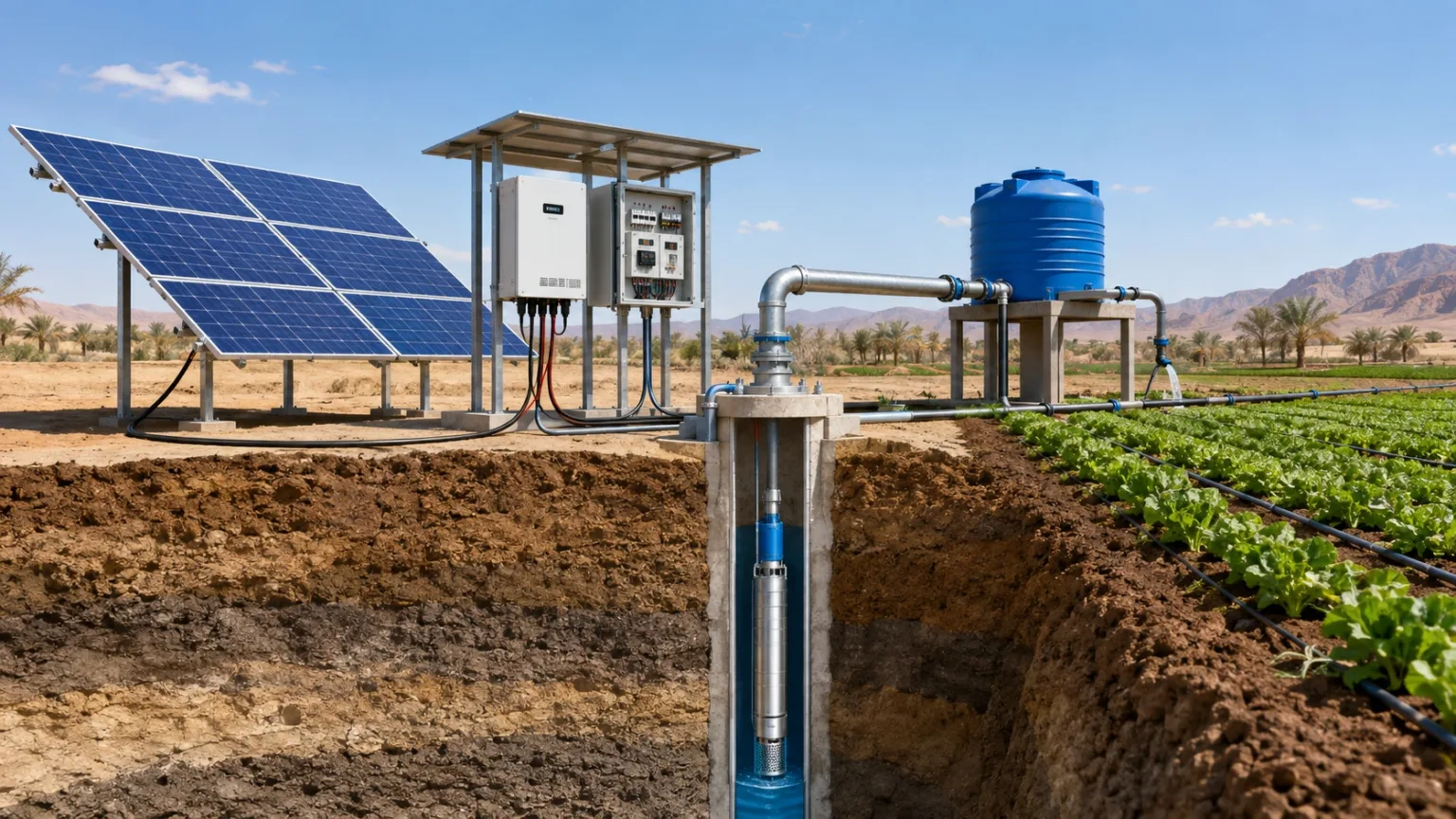
Running Pumps and Submersible Pumps on Farms
Pumps are among the most important loads when designing an on-grid solar system for farms.
A set of data needs to be known before designing the system, such as:
- The pump motor’s power.
- Well depth.
- The required water lift.
- Number of operating hours.
- The required water flow rate.
- Pump operating times.
- Whether there’s a grid connection at the site.
- Other loads running at the same time.
A distinction should be made between a grid-tied solar system that covers part of the farm’s consumption and a system dedicated to running a pump or submersible pump directly; the right solution depends on the nature of the project.
The Difference Between an On-Grid System and a Standalone Submersible Pump System
When studying solar power for farms, customers can confuse several types of solutions.
On-grid system: uses solar power alongside grid electricity to reduce the consumption drawn from the grid.
Submersible pump system: designed around the pump’s capacity, operating hours, and water needs, and may differ in its components and operation.
Off-grid system: works without a grid connection and usually needs batteries to store electricity if loads need to run after sunset.
You can look at Shahen’s off-grid systems to compare them with the on-grid system.
Connecting the Solar System to the Farm’s Electrical Infrastructure
Installation isn’t limited to mounting panels and fitting the inverter; the farm’s electrical system needs to be studied as a whole.
Items to review include:
- Distribution boards.
- Supply voltage.
- Breakers.
- Cable routes.
- Surge protection.
- Earthing.
- Inverter locations.
- Large loads.
- The connection point.
- The safety and connection requirements that apply to the project.
That’s why it’s important for the design and installation to be carried out by a specialist team that can study the solar and electrical sides together.
Does an On-Grid System Need Batteries?
An on-grid solar system for farms usually doesn’t need batteries in its conventional form, because the grid supplies electricity when panel production is lower than the farm’s consumption.
This is one of the key differences compared with off-grid systems.
But if the farm owner wants to store electricity for use at another time or provide a backup source for specific loads, a different system or a hybrid solution with suitable storage should be studied.
You can browse the Shahen solar store to see the batteries, inverters, and solar system components available.
The Cost of Installing the System on Farms
The cost of an on-grid solar system for farms varies with the size of the project, the system capacity, and the components required.
Cost is affected by factors such as:
- The system’s total capacity.
- Number of panels.
- Panel type and efficiency.
- Type and number of inverters.
- Installation area and location.
- Mounting structures.
- Cable lengths.
- Distribution boards and protection.
- The nature of the site.
- Design and installation work.
- Monitoring and maintenance.
So it isn’t accurate to calculate the cost from the price of the panels alone.
How to Calculate the Feasibility of an On-Grid Farm System
It’s best to evaluate the project as a long-term investment, not just the cost of buying equipment.
Start by gathering this data:
- Total annual electricity consumption.
- The value of electricity bills.
- Consumption during daylight hours.
- The proposed system capacity.
- Expected annual production.
- Installation cost.
- Maintenance costs.
- The expected service life of components.
- Warranties.
Then you can compare the project’s cost with the value of the electricity expected to be saved over its service life.
It’s best not to rely on a general savings percentage, because real savings change with the farm’s consumption, system capacity, and available space.
Solar Power and Irrigation Systems
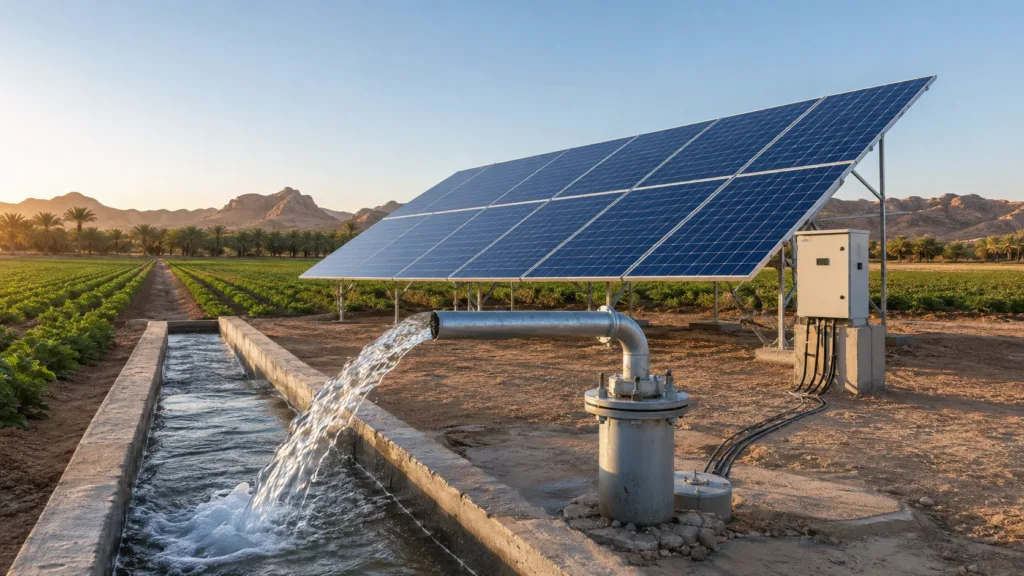
Solar power can be integrated with irrigation systems, especially when pumps run during the day.
Applications may include:
- Drip irrigation.
- Center-pivot irrigation.
- Pumping water to tanks.
- Running well pumps.
- Moving water between parts of the farm.
- Running control and monitoring systems.
But the system capacity required varies greatly depending on the type of pump, operating method, flow rate, and pumping head.
So technical calculations should be carried out before deciding the number of panels.
The Importance of Surveying the Farm Before Design
The success of an on-grid solar system for farms depends on knowing the actual conditions at the site.
The survey helps determine:
- Where the panels will go.
- Mounting orientation.
- Sources of shading.
- The distance between the panels and electrical boards.
- Inverter location.
- The type of ground.
- The location of wells and pumps.
- Cable routes.
- Potential for future expansion.
Cleaning and Maintenance in an Agricultural Environment
Panels at agricultural sites need regular attention because of dust, sand, and the surrounding conditions.
Maintenance includes:
- Inspecting the panels.
- Cleaning them when needed.
- Inspecting the structures.
- Checking that cables are intact.
- Inspecting inverters.
- Reviewing breakers and protection.
- Monitoring production data.
- Making sure no new sources of shading have appeared.
You can look at Shahen’s maintenance and technical support services to learn more about monitoring solar systems.
Monitoring an On-Grid Farm System
Regular monitoring helps detect drops in production early instead of waiting for an obvious fault.
For example, a drop in production compared with previous periods may indicate:
- Dust build-up.
- New shading.
- A problem in one of the panel strings.
- A fault in the connections.
- An inverter problem.
- A change in operating conditions.
That’s why it’s best to keep a production log and compare it regularly.
Why Choose Shahen for Farm Solar Systems?
When installing an on-grid solar system for farms, Shahen offers a complete journey that starts with a needs study and extends to design, supply, installation, commissioning, and maintenance, along with submersible pump solutions for agricultural projects.
The company’s services include:
- On-grid systems.
- Off-grid systems.
- Submersible pump solutions.
- Design and consulting.
- Component supply.
- Installation and commissioning.
- Maintenance and technical support.
You can visit the Shahen website or browse the Shahen store on Salla to learn about solar products and components.
How to Compare Solar Company Offers for Farms
Don’t rely on the final price alone.
Make sure the offer states:
- System capacity.
- Number of panels.
- Panel power and type.
- Inverter type and capacity.
- Expected production.
- Details of the mounting structures.
- Cables and protection.
- The scope of installation work.
- Pump operating requirements, if any.
- Warranties.
- Maintenance services.
- Work not included in the price.
Comparing these items helps you see the real difference between offers.
Mistakes to Avoid Before Installing the System
The most important mistakes that can affect the success of an on-grid solar system for farms include:
- Buying panels before studying the loads.
- Relying on a single month’s bill.
- Ignoring pump operating hours.
- Not studying the consumption curve.
- Choosing the inverter on price alone.
- Not surveying shaded areas.
- Using unsuitable cables and protection.
- Installing a system larger than needed without a study.
- Ignoring future expansion.
- Not planning for cleaning and maintenance.
An on-grid solar system for farms gives agricultural project owners the chance to use solar production during the day and reduce the electricity drawn from the grid, especially when pumps, irrigation, cooling, and other loads run at the same time as the panels produce power.
But the project’s success depends on studying consumption, operating hours, and pump capacity, surveying the site, and choosing compatible panels, inverters, and protection, then installing and monitoring the system properly.
Shahen provides solutions that include needs studies, design, supply, installation, commissioning, maintenance, and submersible pump solutions for agricultural projects. So if you’re planning an on-grid solar system for farms, start by preparing your electricity bills, pump data, operating hours, and water needs, then request a technical site study to get a system that fits the farm’s actual needs instead of relying on general estimates.
Frequently Asked Questions
Does an on-grid system suit every farm?
It suits farms that have access to the grid and can use solar production during daylight hours, but determining its feasibility requires a study of consumption and loads.
Can solar power be used to run submersible pumps?
Yes. Solutions can be designed to run well pumps and submersible pumps according to the pump’s capacity, the well depth, the amount of water required, and operating hours.