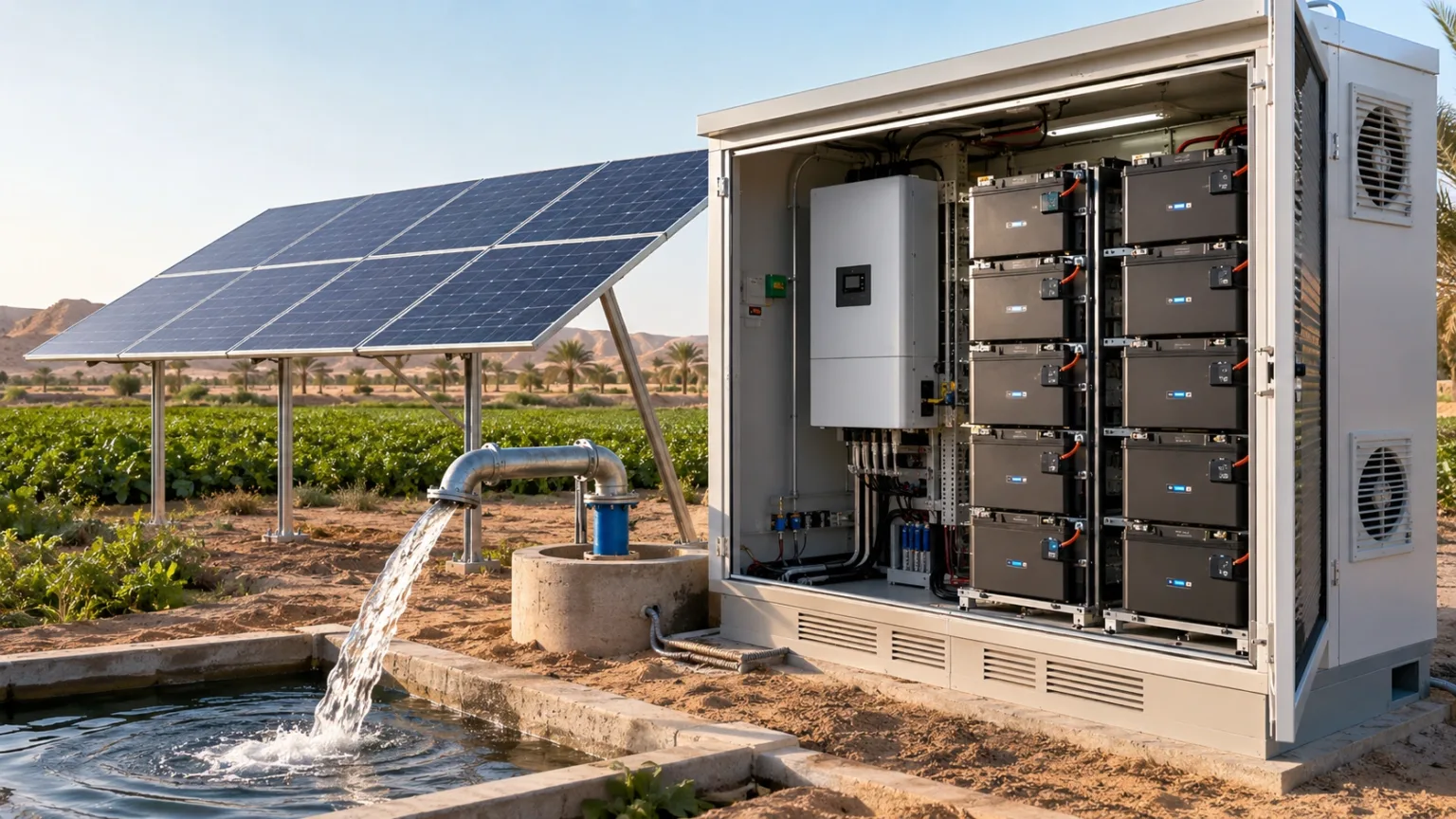
Solar batteries for submersible pumps are an important component in some solar-powered water pumping systems, especially when the pump needs to run while sunlight is low or absent. Shahen Al-Awla provides solar solutions that can be designed around the needs of farms, wells, and other projects, choosing the right components in terms of power, capacity, and type of use.
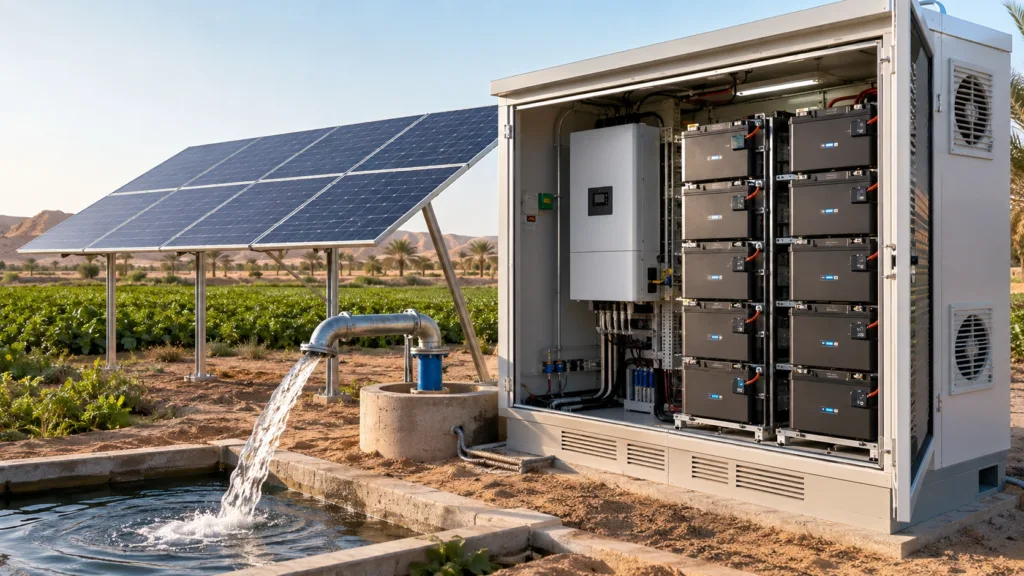
What Are Solar Batteries for Submersible Pumps?
Batteries in solar energy systems store the electricity the panels produce while the sun is shining, then supply that stored energy when it is needed.
In water pumping systems, batteries can provide the energy needed to run the submersible pump during periods when the panels aren’t producing enough electricity, such as the evening hours or when solar irradiance is low.
But batteries are not a requirement in every solar water pumping system. In some projects, the pump can run during the day and the water can be stored in a tank for later use, which can be a better solution than storing electricity in some cases.
Read more:
Solar panel prices in Saudi Arabia
Solar batteries in Saudi Arabia
Hybrid solar energy projects
Home solar installation in Saudi Arabia
The cost of solar energy for farms
Why Use Batteries With Solar Submersible Pumps?
Batteries provide a stable power source when the available solar energy isn’t enough to run the pump.
Their main uses include:
- Running the pump after sunset.
- Supporting operation during periods of weak sunlight.
- Providing backup power for the pump.
- Improving the operating stability of some systems.
- Making use of stored solar energy.
- Reducing reliance on the grid in some applications.
The decision to install batteries depends on the nature of the project, the required operating hours, system cost, and how water is stored.
Do All Submersible Pumps Need Solar Batteries?
The answer is no. Not every solar water pumping system needs batteries.
If the project only needs to pump water during the day, the system can be designed so that the pump runs directly from the solar panels and the water is stored in a tank for later use.
If there is a real need to run the pump at night or when panel output is low, batteries may become an important part of the system design.
So decide how the system will be used before buying batteries, because adding batteries without a study can raise project costs without any real benefit.
Types of Solar Batteries Suitable for Submersible Pumps
Batteries used in solar systems differ in technology, capacity, lifespan, maintenance, and cost.
The best-known types include:
Lead-acid batteries
One of the traditional types used in some solar systems, they have a relatively lower upfront cost, but some types need maintenance and adequate ventilation.
The main variants are flooded lead-acid batteries and sealed batteries.
AGM batteries
AGM batteries are sealed batteries used in some solar energy systems.
They need less maintenance than some traditional batteries and can be used in different applications depending on the system specifications.
Gel batteries
Gel batteries are used in some solar systems and are designed to need less maintenance than traditional flooded batteries.
Make sure the battery suits the required charge and discharge cycle before using it with a submersible pump.
Lithium batteries
Lithium batteries are among the modern options for storing solar energy, and they usually offer high efficiency, a good service life, and the ability to handle repeated charge and discharge cycles.
One of the best-known lithium technologies used for energy storage is lithium iron phosphate, known as LiFePO4.
A lithium battery should be chosen based on the manufacturer’s specifications and the requirements of the pumping system and inverter.
How Do You Choose Solar Batteries for Submersible Pumps?
Choosing solar batteries for submersible pumps depends on several technical factors, not on nominal capacity alone.
The most important factors to study are:
Pump power
The more powerful the pump motor, the more energy it needs to run, so you may need a battery or battery bank with a larger capacity.
Operating hours
Determine how many hours you want to run the pump from the batteries.
Running the pump for one hour is completely different from running it for five or six hours.
Daily energy required
Calculate the pump’s consumption over the operating period, then determine the storage capacity required.
Depth of discharge
Batteries differ in how well they tolerate repeated discharge, so take the permitted depth of discharge into account according to the battery type and the manufacturer’s instructions.
Temperature
High temperatures can affect battery performance and lifespan, so choose an installation location that provides good operating conditions.
Battery compatibility with the inverter
Make sure the battery voltage and capacity are compatible with the inverter and with the battery management system when using lithium batteries.
Calculating the Battery Capacity a Pump Needs
One of the most important steps in designing solar batteries for submersible pumps is determining the required energy accurately.
Put simply, you can estimate the required energy by multiplying the load’s power by the number of operating hours.
If a pump draws 2,000 watts and needs to run for 3 hours, the theoretical energy required is 6,000 watt-hours.
But the actual battery capacity must account for additional factors, including:
- Inverter efficiency.
- Battery efficiency.
- Permitted depth of discharge.
- Temperature.
- Cable losses.
- Operating conditions.
- Charge and discharge rate.
That’s why you shouldn’t rely on the theoretical calculation alone when building a real system; a complete technical study is needed.
Storing Electricity vs. Storing Water
When designing a solar pumping system, there are two basic ways to supply water when there’s no sun.
The first is to store electricity in batteries; the second is to run the pump during the day and store the water in a tank.
In some agricultural applications, storing water can be simpler and more economical, because a tank can supply water at different times without the need for large batteries.
In projects that require the pump to run at night or that need a continuous power source, storing electricity may be the right choice.
The best solution is determined by the nature of the project, not by one rule for every use.
The Role of the Inverter With Pump Batteries
The inverter is an essential element in systems that combine batteries and pumps, because it manages power and converts it into the form needed to run the motor.
When using solar batteries for submersible pumps, make sure the inverter supports the battery type and that its capacity suits the pump.
The motor’s starting current must also be considered, because some motors need a higher current at start-up than during normal operation.
Choosing the inverter therefore doesn’t depend only on the pump’s rated power; the motor’s characteristics and operating method must be studied.
Are Lithium Batteries Better for Submersible Pumps?
Lithium batteries, especially LiFePO4, have several characteristics that make them an attractive option for solar energy storage.
Their main advantages include:
- Good energy density.
- High efficiency.
- A relatively long service life.
- Good tolerance of charge and discharge cycles.
- Lower weight than some lead-acid batteries.
- Low maintenance needs.
- The ability to use a larger share of the capacity, depending on the battery specifications.
But that doesn’t mean lithium is the best choice for every project. The higher upfront cost can be an important factor, and other batteries may be better suited to some uses.
So carry out an economic and technical comparison before deciding.
Benefits of Using Batteries With Solar Submersible Pumps
Solar batteries for submersible pumps can offer several benefits when the system is designed correctly.
Running the pump at different times
Energy can be stored during the day and used when needed, giving the system more operating flexibility.
Reducing reliance on the grid
Batteries can help reduce the need for conventional electricity in some applications.
Making use of energy produced during the day
Instead of relying only on what the panels produce at the moment of operation, part of the energy can be stored for later use.
Supporting operation when irradiance is low
Batteries can supply the energy needed during periods when the panels produce less electricity.
Drawbacks and Challenges of Solar Batteries
Despite their benefits, batteries come with some challenges to keep in mind.
Higher upfront cost
Adding a battery bank can noticeably raise project costs, especially when a large capacity is needed.
Lifespan
Batteries have a limited service life compared with solar panels, and how long they last depends on the battery type, the number of charge and discharge cycles, and operating conditions.
Heat
High temperatures can affect the life and performance of some batteries, so a suitable installation location is needed.
The need for a suitable management system
Especially with lithium batteries, where the battery management system (BMS) is an important part of the protection and monitoring setup.
How to Install Batteries Correctly
Batteries must be installed in a suitable, safe location according to the manufacturer’s instructions.
The main considerations include:
- Providing adequate ventilation where needed.
- Protecting the batteries from high temperatures.
- Keeping them away from water and humidity.
- Using cables rated for the current.
- Installing the required protection devices.
- Ensuring correct polarity.
- Following the charge and discharge specifications.
- Leaving enough space for inspection and maintenance.
Wiring should be done by a qualified technician, especially with battery banks of high voltage or current.
Maintaining Solar Pump Batteries
The maintenance required depends on the battery type.
In general, you should monitor:
- Battery voltage.
- State of charge.
- Temperatures.
- The condition of connections.
- Any swelling or visible damage.
- Battery performance during charging and discharging.
- Battery management system data, where available.
For batteries that need regular maintenance, follow the manufacturer’s instructions carefully and never neglect safety procedures.
Signs of a Weak Battery
Several signs can appear when a battery’s efficiency drops, including:
- Shorter pump running time.
- Voltage dropping quickly.
- Needing to charge more often.
- Abnormally high temperature.
- Warnings on the inverter.
- A reduced ability to hold charge.
In this case, the battery and the whole system should be checked, because the problem may be related to charging, the inverter, or the loads rather than the battery itself.
How Many Batteries Does a Submersible Pump Need?
The number of batteries can’t be determined from the pump’s power alone, because it depends on the required voltage, the required capacity, and the operating duration.
For example, a system may need several batteries connected in series to reach a certain voltage, while other strings are connected in parallel to increase storage capacity.
The battery bank should therefore be designed based on:
- System voltage.
- Pump power.
- Operating hours.
- Battery capacity.
- Maximum discharge.
- System efficiency.
- Inverter capacity.
Pump Batteries on Farms
Farms need flexible water pumping solutions, especially when wells are far from the electricity grid.
Batteries can be used where the pump needs to run at times when the sun isn’t available.
But before installing batteries, consider whether a water tank could reduce the size of the electrical storage system, especially if the goal is to provide irrigation water rather than electricity itself.
Cost of Solar Batteries for Submersible Pumps
The cost of solar batteries for submersible pumps varies with battery type, capacity, voltage, brand, and technology.
Cost is also affected by factors such as:
- Number of batteries.
- Battery type.
- Storage capacity.
- Expected service life.
- The battery management system.
- The inverter.
- Cables and protection.
- Installation costs.
It’s best not to compare prices on the total price alone, but to compare cost against capacity, expected lifespan, number of charge cycles, and efficiency.
How Can You Reduce the Cost of a Battery System?
You can reduce system costs by determining the real operating need instead of installing more storage capacity than necessary.
Practical solutions include:
- Determining the pump’s operating hours accurately.
- Using a tank to store water where suitable.
- Choosing an efficient pump.
- Improving the design of the water network.
- Reducing energy losses in cables.
- Choosing a compatible inverter.
- Comparing different battery technologies.
- Relying on a technical study before buying.
Common Mistakes When Choosing Batteries
Some mistakes can raise costs or reduce system performance, including:
- Choosing a battery based on price alone.
- Ignoring the pump’s power.
- Not calculating operating hours.
- Using batteries that aren’t compatible with the inverter.
- Ignoring depth of discharge.
- Installing batteries in a very hot location.
- Not providing electrical protection.
- Choosing less capacity than needed.
- Installing far more capacity than needed.
Correct design is the most important step to avoid these problems.
Shahen Al-Awla’s Role in Choosing Batteries
Solar water pumping systems need a complete study covering the panels, the pump, the inverter, the batteries, and the water network.
Shahen Al-Awla provides solar solutions that can be adapted to the nature and needs of each project, with care taken to choose components that match the pump’s power, the available energy, and the storage capacity.
Before building any system, determine the amount of water required, operating hours, well depth, and flow rate, then base the design on this data.
Tips Before Buying Batteries
Before buying solar batteries for submersible pumps, review the technical specifications and don’t rely on the product name or price alone.
The most important tips include:
- Determine the pump’s power accurately.
- Calculate the required operating hours.
- Determine the system voltage.
- Choose a battery suited to the type of use.
- Make sure the battery is compatible with the inverter.
- Check the usable capacity.
- Review the warranty terms.
- Ask about expected lifespan and cycle life.
- Pay attention to the temperature at the installation site.
- Rely on a specialist when designing the system.
Solar batteries for submersible pumps are an important option in water pumping systems that need to store electricity and run the pump at times when there isn’t enough solar energy. However, having a solar pump doesn’t mean batteries are always necessary; storing water in a tank may be a better solution for some projects.
The right choice depends on the pump’s power, operating hours, the amount of water required, system voltage, inverter type, and site conditions. Battery types should also be compared on capacity, efficiency, lifespan, and cost before deciding.
With a complete technical study and compatible components, you can build a more efficient and stable solar pumping system and use solar energy to reduce water pumping costs over the long term.